“The launch of Dessa AI represents an interesting development in the evolution of speech-to-speech artificial intelligence.” Dessa speech-to-speech AI is Block’s full-duplex voice model, designed to process and generate speech directly from audio. In this article, we explore its reported architecture, potential applications, limitations, and how it compares with AI voice tools such as ChatGPT Voice. Voice AI traditionally works by converting speech to text, running a language model, then synthesizing speech again – a process that strips away tone, emotion, and spontaneity. Block’s new Dessa AI flips this pipeline on its head. Announced in October 2026, Dessa is a full-duplex, end-to-end speech-to-speech model: it takes raw audio in and generates audio out, with no text step at all. In practice, this means Dessa can listen and speak simultaneously (like a human), laugh mid-sentence, backchannel (e.g., “yeah,” “uh-huh”), and adjust volume on cue. The system was trained exclusively on recorded human conversations – no text transcripts, no pretrained models – and runs on a single high-end GPU (NVIDIA GB200 NVL72).
Block’s lab reports that every behavior of Dessa was learned from speech alone. In demos, when a human partner hesitates, Dessa can finish their sentence correctly; when something is funny, it laughs mid-utterance. Because it never converts voice to text, it naturally captures nuances like sarcasm, sighs, tears, and emotion that text-based systems miss. Block positions Dessa as “the most authentic full-duplex speech model ever built,” suggesting it could make voice interactions far more natural.
However, it’s important to note that Dessa is currently a research preview, not a product. Block has released demo recordings and invited a small group of AI safety researchers to experiment with it – there is no public API or release date yet. The model’s architecture and weights have not been published, and independent benchmarking isn’t available yet. In short, Dessa overturns old assumptions about voice AI, but much remains unverified.
Table of Contents
How Does Dessa Speech-to-Speech AI Work?
“Unlike conventional voice assistants, Dessa AI is designed to process incoming speech and generate spoken responses without relying on an intermediate text transcript.”Traditional voice assistants follow a pipeline: Audio ➔ Speech Recognition (ASR) ➔ LLM (text) ➔ Text-to-Speech (TTS) ➔ Audio. Dessa replaces all of that with one end-to-end neural network. Conceptually, the pipeline is:
In other words, input audio (e.g., from a microphone) is converted into acoustic features (like Mel-spectrogram frames), fed into a single “Dessa” model, and the model directly generates speech audio back through a vocoder. Crucially, there is no intermediate text or language model stage. Because it’s full-duplex, the model generates output in real time while still receiving input – so it can interrupt or respond on the fly just like a human conversation partner.
Block’s descriptions highlight that the model learned turn-taking and backchannel behaviors from conversation data. For example, it knows when to interrupt politely and when to offer brief affirmations (“got it,” “uh-huh”) while listening. The system even handles volume cues: asking it “please speak up” makes the output louder without retraining. All this happens because the model was exposed to audio of real conversations from scratch.
In practice, the model is implemented as a deep neural network (exact architecture undisclosed). Training used 72 NVIDIA Blackwell GPUs (GB200 NVL72) on many hours of conversation. Block emphasizes the difficulty: “one spoken sentence carries thousands of times more bytes than the same sentence as text,” and no spoken sentence is repeated verbatim. Despite that, Block reports that “inference runs faster than real time” on a MacBook Pro with an M4 Max chip or better. This means the end-to-end model can actually run live on high-end consumer hardware, an impressive technical feat.
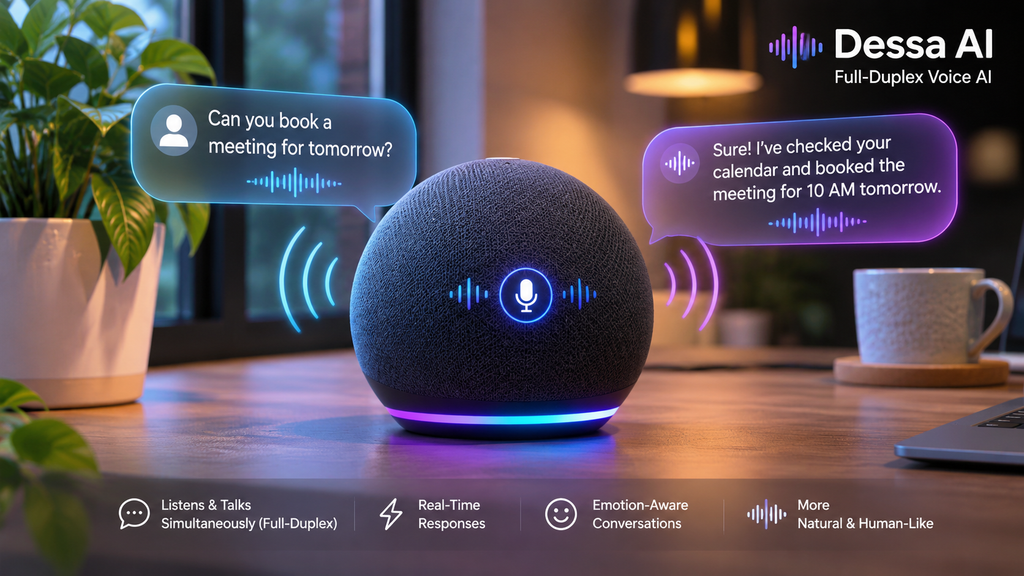
Technical Highlights and Training
- Training Data: Human conversation audio only. No text transcripts or pretrained LLMs were used. Block claims that means every word and fact Dessa “knows” comes from hearing people talk.
- Compute: Block trained on a single server with 72 NVIDIA GB200 GPUs and associated CPUs. (For context, the open-source Moshi model required 1,016 NVIDIA H100 GPUs.) In other words, it was expensive but not on the scale of massive LLM training runs.
- Model Size: Not disclosed. Block has not revealed the number of parameters or the exact architecture. No weights or model card have been released.
- Inference: Claimed to be faster-than-real-time on powerful laptops (M4 Max MacBook Pro or better). This local performance implies latency on the order of milliseconds, suitable for fluid conversation.
- Features Learned: Because it trains on raw audio, Dessa inherently captures pitch, intonation, emotion, and timing. It has demonstrated laughter, breathy noise, and changes in tone. These are normally stripped away by typical ASR–LLM pipelines.
Block’s team also notes that Dessa learned to speak after hearing hundreds of times fewer words than what text-based LLMs use. In other words, one could say it’s much more data-efficient (in raw bytes) than text-only approaches – but this is still an open claim requiring independent analysis.
Limitations: As of late 2026, Dessa is a research prototype. There are no published benchmarks showing accuracy or naturalness compared to other models. We don’t know, for example, how it handles multi-speaker noise or rare vocabulary. Some demos even show it “hallucinating” (talking about things unrelated to the prompt) or misidentifying who’s speaking. Until the model weights or code are public (and third parties verify performance), we should treat all claims cautiously.
Use Cases and Applications
If fully realized, Dessa’s technology could transform many voice interfaces. Because it fundamentally understands emotion and timing, it can power agents that feel more empathic and natural. Potential applications include:
- Customer Service Agents: Automated call-center bots that can interrupt politely, acknowledge with “oh…” or laughter, and detect if a customer is upset.
- Digital Assistants: Home assistants (like smart speakers) that can hold a normal back-and-forth conversation, unlike today’s assistants that wait for complete commands. For example, Alexa or Google Home powered by Dessa might correct itself mid-sentence or respond instantly without asking “did you say X?” repeatedly.
- Accessibility Tools: Real-time translation or transcription aids that not only translate words but also preserve tone and emphasis for hearing-impaired users.
- New Interfaces: Simply speaking to computers and appliances in a fluid way. Block itself envisions voice as the “most natural way to interact with intelligence”, and a model like Dessa could make AI companions feel more human-like.
In demos, Dessa often “remembers” context (like a user’s gender or preferences) and even corrects disfluencies (“you forgot the movie name, let me fill that in”). This suggests potential for long-running conversations, not just one-shot Q&A.
However, because Dessa’s knowledge comes solely from its training audio, it might know less factual trivia than an LLM like ChatGPT. (Block notes this as a research question: does audio-alone learning find knowledge differently than text-based models?) For now, imagine Dessa as a conversational frontend: it could handle the voice interaction, while a backend LLM provides factual answers when needed.
Comparison: Dessa AI vs Other Voice AI Models
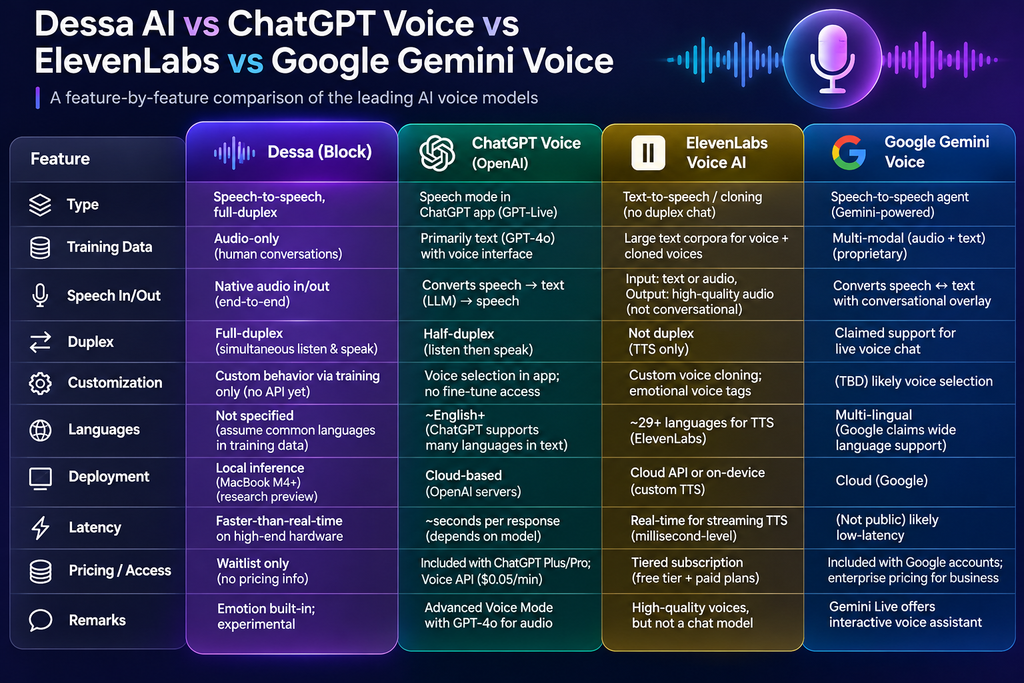
Above, ChatGPT Voice (GPT-Live) currently handles voice by transcribing to text and using GPT-4o for replies. A premium “Advanced Voice Mode” is said to skip the text step, but OpenAI’s documentation confirms ChatGPT still uses GPT-Live with explicit voice settings. Google’s Gemini (also known as Bard) has a “Live” mode for voice chat; details are emerging, but it generally follows a speech-to-text LLM-to-speech pipeline. ElevenLabs specializes in TTS and voice cloning (e.g., emotional voice tags for synthesized speech) but isn’t designed for freeform dialogue by itself.
Notably, Dessa’s claim of training without text at all is unique. For example, the Kyutai team’s Moshi model started with a text-based LLM backbone. NVIDIA’s PersonaPlex also fine-tuned from an existing speech model. ChatGPT Voice relies on OpenAI’s large language model. By contrast, Dessa skips the LLM step – an architecture shift that could change performance and cost trade-offs.
Limitations and Challenges
Dessa is a research preview, not a finished product. Block has been transparent that many details are undisclosed. There are zero published benchmarks or public evaluations. We simply don’t know how it performs on objective metrics (e.g., intelligibility, latency under load, robustness to noise). Moreover, because it has never seen written language, it might struggle with world knowledge learned from text. Early demos show occasional misfires and topic drift.
Other practical limitations include:
- Vocabulary and Knowledge Gaps: If the training data didn’t include certain facts or names, Dessa may not know them, unlike text-based models trained on huge text corpora.
- Deployment Complexity: Running real-time speech AI on-device requires optimized code. Block hasn’t said if an efficient runtime or compiler (e.g., TensorRT) is provided. As of now, only their MacBook demo exists.
- Scalability: Training on raw audio is expensive (storage, compute). The one-GPU training was likely very costly, which may limit how often it can be retrained or updated.
- Safety Risks: A highly natural-sounding AI could fool users. Block themselves are giving early access only to AI safety researchers to probe failure modes. Voice AI that intentionally imitates human nuance may raise new concerns (more below).
In summary, Dessa is a promising experiment but still an unproven technology. Any claims about it being “first” or “best” are Block’s claims. Independent evaluation is needed.
Ethical and Privacy Considerations
Dessa’s ability to hear and express emotion raises both opportunities and risks. On one hand, if an AI can detect sadness or distress in a caller’s voice, it could respond with empathy or route a user to help. On the other hand, there are privacy implications: all those vocal cues could be misused. For instance, the model might (unintentionally) infer sensitive traits (health conditions, emotional states) from voice. Any deployment would need strict consent and data governance.
Block explicitly mentions safety as a goal: if “an AI can hear pain in a voice, it should not keep talking mechanically.” However, giving an AI the power to judge emotional states could be misused, e.g., by deceptive voice agents. Atlabyte notes that the more realistic a voice agent sounds, the easier it might be to deceive someone. Therefore, ongoing safety audits are crucial. Block’s invitation to safety researchers suggests they are aware of these issues.
Privacy is also a concern. Since Dessa processes raw audio locally, in principle it’s safer than a cloud service. However, training data must come from somewhere – Block says “recorded human conversation,” but doesn’t detail consent or anonymization. Future versions of such tech should ensure any voice data used respects privacy laws.
Future Outlook
The release of Dessa signals a possible shift in voice AI. If successful, full-duplex models could replace today’s pipeline bots, enabling much more fluid human-machine dialogue. This might make voice interfaces cheaper and faster by eliminating large LLM inference per turn, and allow completely offline voice agents on devices.
For Block (a financial-tech company behind Square, Cash App, etc.), Dessa could power new features in payments or commerce – for example, voice-activated ordering in restaurants (Square’s domain) that truly “understands” you. Jack Dorsey’s involvement suggests the project has high priority. However, broad adoption depends on the model’s openness. Block has not released a timeline or pricing. (One reference suggests ChatGPT Voice API costs about $0.05 per audio-minute, but no such numbers exist for Dessa.)
Other companies are also racing. OpenAI is enhancing ChatGPT’s voice mode (GPT-4o). Google and Amazon continue to refine their assistants. NVIDIA is developing conversational voice models (PersonaPlex) for enterprise. Dessa’s unique angle is the audio-only training, which could either prove a breakthrough (if it generalizes well) or a dead end (if text still reigns).
As of late 2026, Dessa remains an exciting research result. Its future might include open-sourcing (like OpenAI did with GPT models) or licensing to developers, but no announcements are out. The immediate next steps will likely be more demos and independent testing. Observers should watch for formal papers or releases to understand whether Block’s claims hold up in practice.
Conclusion
Block’s Dessa AI represents a bold experiment: teaching a machine to talk only from sound, without text. It challenges the conventional wisdom of voice AI and shows some impressive conversational abilities in demos. We’ve explored its technical approach, potential uses, and how it compares to other voice systems. While the hype is real, caution is warranted – Dessa is still a research preview with many unanswered questions.
In summary, Dessa could herald a new generation of voice agents if its claims are borne out. It leverages the richness of speech (emotion, timing, etc.) that text-based systems ignore. For now, we’ll watch closely as Block provides more data and invites researchers to probe this technology. In any case, comparing it to ChatGPT Voice and others shows an evolving landscape: one where future AI assistants might not just understand what we say, but how we say it.
Frequently Asked Questions (FAQ)
How does latency compare? Block claims inference is faster-than-real-time on a Mac M4 Max or better. ChatGPT Voice typically responds within a few seconds. The actual latency will depend on the hardware and implementation.
What is Dessa AI? Dessa is a full-duplex speech-to-speech AI model from Block’s research lab. It listens and speaks simultaneously, trained entirely on human voice recordings with no text intermediate.
How does Dessa differ from ChatGPT’s voice mode? ChatGPT Voice currently uses speech-to-text plus GPT-4o plus text-to-speech. Dessa skips text entirely and is trained end-to-end on audio. This means Dessa inherently handles intonation and interruptions, whereas ChatGPT’s system still follows a listen-then-speak pipeline.
When will Dessa be available? As of now, it’s a research preview with no public release date or pricing. Block has opened a waitlist for safety researchers. Users should not expect a consumer product imminently.
Can I use Dessa for my app? Not yet. Block has not released an API or model weights. Competitors like ChatGPT do offer voice APIs (e.g., $0.05 per minute), but Dessa itself is not yet accessible.
Is voice data safe with Dessa? Because Dessa runs locally (e.g., on-device), in principle it can be more private than cloud systems. However, using raw audio can leak emotion and identity information. Block emphasizes safety research due to these concerns.
What languages does Dessa support? Block hasn’t specified languages. We assume primarily English (based on demos). Supporting more languages may require additional multilingual training.
Leave a Reply