
Introduction to Claude Fable 5.2
Claude Fable 5.2 is a real, state-of-the-art large language model released by Anthropic on November 9, 2026. It is part of Anthropic’s “Claude” series of models and is developed by Anthropic (the same company behind the Claude AI assistant). Anthropic positions Fable 5.2 as its flagship model for the most ambitious, open-ended technical work – tasks that require extensive multi-step reasoning, long-term planning, and continuous supervision. Unlike Anthropic’s “Mythos” variant (which is restricted to vetted organizations for sensitive work), Claude Fable 5.2 is generally available under standard access plans. It carries robust safety controls but still allows broad use (subject to a mandatory 30-day data retention policy; see the Data Retention section).
Fable 5.2 was built specifically for advanced reasoning and agentic applications. It inherits the massive 1,000,000-token context window of its predecessor and sibling models, but with a focus on handling tasks that span many steps and hours of computation. In fact, Anthropic’s documentation explicitly describes Claude Fable 5.2 as being built “for demanding reasoning and long-horizon agentic work”. In practice, this means Fable 5.2 is aimed at workflows where the AI breaks down problems, coordinates subtasks or agents, and iteratively solves complex problems (see below).
Anthropic claims that Fable 5.2 brings substantial improvements over its predecessor (Fable 5.1) in reasoning, coding, and even vision. Early reports highlight faster generation speeds (up to ~30% faster per token) at lower cost, better mathematical and logical reasoning, and stronger support for multi-step software and science tasks. In short, Claude Fable 5.2 represents Anthropic’s new “frontier” AI model, and it has drawn attention as one of the first models explicitly designed to serve as a high-level AI agent or orchestrator in complex projects.
Table of Contents
What Is New in Claude Fable 5.2?
The Fable 5.2 release introduces several major upgrades over previous Claude models:
- Improved reasoning and problem-solving. Anthropic reports that Fable 5.2 is much better at logical reasoning, mathematical and scientific problems, and understanding complex instructions, compared to Fable 5.1 or even their Opus 5.5 model. In their internal benchmarks, Fable 5.2 consistently outscored its predecessors on agentic coding tasks and research tasks (see Benchmark Performance below). Users have noted that Fable 5.2 can maintain longer chains of logic and handle ambiguous or under-specified prompts more robustly.
- Advanced agentic capabilities. Fable 5.2 is explicitly designed for agentic AI workflows. Anthropic’s announcement emphasizes that it can orchestrate multiple smaller AI agents, self-verify its work, and execute tasks that span many steps or even days. For example, Anthropic describes giving Fable 5.2 a months-long software development project: with thousands of subtasks run in parallel, it produced a working prototype operating system from scratch. In practical terms, this means Fable 5.2 can plan multi-stage tasks (e.g., coding projects, long simulations, research experiments), delegate parts of the task to copies of itself or other tools, and integrate results.
- Better coding and software development. According to Anthropic, Fable 5.2 shows large gains in coding performance and software engineering support. It more accurately understands and generates code, reads large codebases, and even debugs or refactors. In their example usage, Fable 5.2 fixed “stubborn bugs in minutes”, optimized services, and guided a production migration from Python to Rust using over a thousand sub-agents working concurrently. In benchmarks, Fable 5.2 scored about 30–50% better than Fable 5.1 on advanced coding tests, approaching or exceeding competitors like GPT-6 and Gemini in agentic coding tasks.
- Enhanced vision capabilities. While Fable 5.2 is primarily a text model, it also supports image inputs (with one of the largest supported context lengths). Anthropic indicates it has better image understanding than before. In particular, Fable 5.2 can take diagrams, charts, or photos as inputs and reason about them. For example, one of the published benchmarks (Chartography) tests reading graphs without tools; Fable 5.2 performed well on that too. The details on vision aren’t as publicly detailed, but Anthropic lists “vision” among the key improvements in Fable 5.2.
- Faster generation and new “fast mode.” Fable 5.2 is reported to generate text faster than Fable 5.1 – Anthropic claims up to 30% faster per token under the new model. To further optimize speed, Anthropic introduced a new fast mode: at double the normal price ($16 per million input tokens, $80 per million output tokens), fast mode can generate tokens about 2.5× faster than the default. Fast mode is useful when latency is critical (for example, UI or real-time apps), while default mode balances speed and cost.
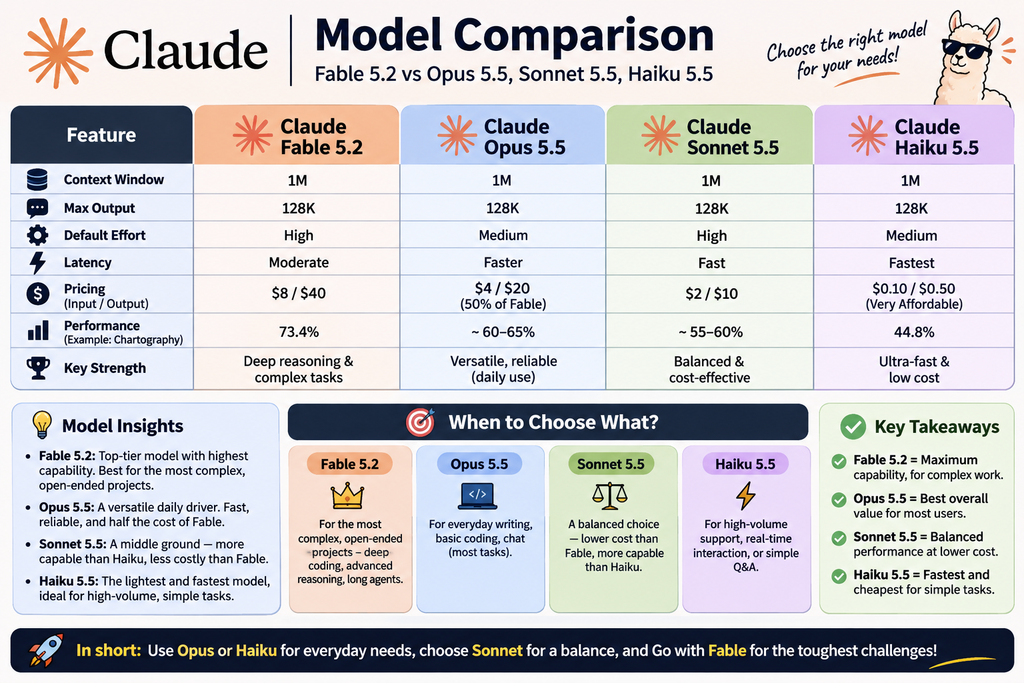
- Lower pricing. Anthropic reduced the base API price for Fable 5.2 compared to Fable 5.1. The standard rates are now $8 per million input tokens and $40 per million output tokens. This is 20% cheaper than Fable 5.1’s $10/$50 pricing. (Fast mode is $16/$80 as noted above.) Cache reads cost $0.20 per million tokens, and batch requests are 50% off. In addition, Anthropic offers an American Cloud Region for an additional 10% cost for lower latency if needed.
- Stronger safety and safeguards. The Fable 5.2 system card reports that it is safer than previous models on many “alignment” dimensions. In internal tests, it was much less likely than older Claude models (Opus 5.5, Sonnet 5.5) to produce harmful content without prompting. Anthropic also built in new guardrails to prevent misuse: for example, some high-risk content categories (especially advanced cybersecurity and biological engineering) are disabled by default (such tasks are deferred to the more restricted Claude Mythos 5.2 variant). Overall, Anthropic says the model’s misalignment rate is very low, though like all LLMs it is not perfect and still requires human oversight for high-stakes tasks.
In summary, Fable 5.2 introduces significant upgrades in speed, reasoning, and capability over earlier Claude models. Its focus on “agentic” tasks – complex workflows spanning hours or days – and its lower price make it a standout offering for developers tackling very challenging problems.

Key points from these specs:
- Adaptive Thinking & Effort: The model uses an “adaptive” chain-of-thought process that is always on; you cannot disable it. Instead, developers control reasoning depth and computation via the
effortparameter. The defaulthigheffort yields the most thorough answers (at higher cost), while medium or low effort use less compute and produce faster responses. - Long Context: Fable 5.2’s 1M token context window (shared with Claude’s other 5.x models) allows it to consider extremely large inputs, document corpora, or codebases without truncation. This is critical for agentic tasks that involve multi-file code or long dialogs.
- High Output Limit: It can produce up to 128K tokens of output in a single response – enough to write whole essays, reports, or generate large code modules in one go.
- Model IDs & Platforms: The official Claude API name is
claude-fable-5-2. On Amazon Bedrock, the model is *anthropic.claude-fable-5-2; *on Google Cloud AI Platform and Microsoft Foundry, it is alsoclaude-fable-5-2. The Cloudflare AI docs note the Cloudflare model handle asanthropic/claude-fable-5-2. In practical terms, developers can access Claude Fable 5.2 through Anthropic’s own API or via major cloud AI marketplaces (AWS, GCP, Azure Foundry). - Pricing: As noted, the new pricing ($8/$40) is lower than the previous Claude Fable 5.1 ($10/$50). For context, Anthropic’s 5.x family has tiered pricing: Opus 5.5 is $4/$20, Sonnet 5.5 is $2/$10, and Haiku 5.5 is only $0.10/$0.50. (All share the 1M context window and 128K output.) Developers should note the cost of using Fable vs. other Claude models when planning projects.
- Data Privacy & Safety: Fable 5.2 enforces a 30-day data retention policy by default. Unlike some lighter models, it is not offered under Anthropic’s Zero Data Retention (ZDR) umbrella without special permission. This means any text passed to Fable 5.2 is logged for at least 30 days. Companies with strict data rules may need to consult Anthropic for exceptions or consider the Mythos variant.
The table above and annotations draw directly from Anthropic’s official documentation. All these specs are confirmed by Anthropic’s product docs and launch announcements. When using the API, developers simply specify model="claude-fable-5-2" in the request and can toggle effort level via the effort parameter in the JSON payload. (See the API Integration section for an example.)
Advanced Reasoning and Agentic Capabilities
Claude Fable 5.2 is explicitly crafted for agentic AI tasks – scenarios where the model acts like a high-level planner or “brain” orchestrating many sub-tasks. In Anthropic’s words, Fable 5.2 can serve as an advisor (consulted by smaller models) or an orchestrator (delegating subtasks to others) in a larger AI workflow. It is designed to handle “ambiguous problems” with self-planning and verification.
In practical terms, this means Fable 5.2 can undertake multi-step tasks that unfold over time. For example, an AI agent built on Fable 5.2 might:
- Plan and track long-running projects: Break down a big goal (e.g., “build a search engine prototype from scratch”) into steps, generate code, launch simulations, check results, and adjust the plan autonomously. Anthropic explicitly describes using Fable 5.2 in 24-hour “agent session” loops for software migrations and research tasks.
- Coordinate many sub-agents: A Fable 5.2 agent can spawn numerous specialized sub-agents (which might each be copies of Fable or a cheaper model) to tackle parts of a problem in parallel. The OS-building case is a dramatic example: Anthropic said a team of 1000 sub-agents ran around the clock for 8 days, each writing, testing, or reviewing parts of an operating system, ultimately producing a working OS. This shows Fable 5.2’s ability to serve as a “manager” agent, directing other AIs to cooperatively solve a large-scale task.
- Iterative self-verification: Because Fable 5.2 can reason about its own outputs, it can continually check and refine results. For instance, in code generation tasks, it can test-run code, spot errors, and debug itself. In scientific tasks, it can run computations or consult tools and then incorporate the results into its reasoning. Anthropic’s benchmarks note that Fable 5.2 is tested with the highest-available “effort” (deep reasoning) settings, suggesting it is indeed geared for exhaustive, iterative problem-solving.
These agentic capabilities distinguish Fable 5.2 from everyday chatbots. Whereas a normal LLM might answer a question or write a short script, Fable 5.2 is intended to “work on problems”—coherently maintaining context and state across hours of work. The model’s architecture (with adaptive chain-of-thought) and training appear optimized for this: it retains an immense context and can break it into reasoning “chunks” during long sessions.
In Anthropic’s documentation, Fable 5.2 is not recommended as the first choice for simple tasks. Instead, Anthropic advises developers to start with the more lightweight Claude Opus 5.5 or Sonnet 5.5 for routine coding and knowledge work, and escalate to Fable (or Mythos) only when the task truly demands it. This is because Fable’s strengths (depth of reasoning, agent control) come with higher latency and cost. But for the hardest tasks – e.g., coordinating a full software development pipeline or performing complex scientific research – Fable 5.2 may be the only model up to the challenge.
Example: Anthropic gives a concrete example of an AI agent using Fable 5.2 to rebuild a production service. In one experiment, engineers tasked Fable 5.2 with migrating a key service from Python to Rust. The model ran dozens of sub-agents in parallel, producing optimized, tested code. The result was a service that started 26× faster than before. This illustrates how Fable 5.2 can tackle software engineering tasks that would be tedious or infeasible for humans alone.
Coding and Software Development Capabilities
One of Fable 5.2’s headline strengths is software engineering. Anthropic reports that over 90% of their own code changes are now driven by Claude, and much of that is on Fable 5.x models. In Fable 5.2, these coding abilities are even more advanced: the model can generate code in many languages, refactor large codebases, design system architectures, write tests, and find bugs.
Key coding-related capabilities and use cases include:
- Code Generation and Comprehension: Fable 5.2 can read and write complex code. It handles large codebases thanks to the 1M context window. It can be given entire projects, understand them, and generate significant new modules. Users report that it can carry the intent of each prompt without misunderstanding, even as the project evolves.
- Architecture and System Design: The model has shown strong skills in high-level design. For example, Anthropic says an engineer used Fable 5.2 to outline a multi-service architecture for a new product without needing to constantly correct or clarify the model. Fable 5.2 itself can propose data schemas, API designs, and system workflows when prompted with functional requirements.
- Debugging and Error Diagnosis: Fable 5.2 excels at identifying and fixing bugs. Because it can self-test code (run it in a virtual environment) and reason about failure modes, it can debug complex issues. Anthropic notes it fixed “stubborn bugs in minutes” in their codebase. In tests, it often finds root causes that prior models missed.
- Large-Scale Refactoring and Migration: As noted, teams have used Fable 5.2 agents to perform large migrations. Its ability to manage long-running workflows makes it suitable for tasks like rearchitecting legacy software. It can coordinate writing automated scripts, rewriting modules, and verifying equivalence.
- Coding Benchmarks: In Anthropic’s FrontierCode 2.0 benchmark (an “agentic coding” test using simulated version control), Fable 5.2 scored 49.1% (X-high effort), outperforming both GPT-6 Astra (42.8%) and Google Gemini 4 Carbon (41.1%) on the same test. This suggests Fable 5.2 is currently best-in-class for multi-step coding tasks, at least according to Anthropic’s evaluation.
- IDE and Tool Integration: The Claude Code tool (an interface for coding tasks) is expected to support Fable 5.2. Developers can thus use it in interactive coding tools or IDEs. Its “thinking” steps will produce structured reasoning that can be rendered as code comments or test results.
Overall, Fable 5.2 is well suited for engineering-level coding work. It is overkill for simple script-writing or language translations, but for building applications, optimizing performance, or automating DevOps, it offers capabilities far beyond a standard assistant. Anthropic advises using it as the top-tier coding model: start with Opus 5.5 for routine tasks, and switch to Fable 5.2 for truly challenging ones.
Scientific Research, Mathematics and Engineering
Claude Fable 5.2 is not limited to coding; Anthropic highlights its potential in science, mathematics, and engineering:
- Scientific Reasoning and Data Analysis: Fable 5.2 can assist in scientific research workflows. For example, it can write and run simulations, analyze experiment data, or help plan research protocols. The model is reportedly capable of performing advanced mathematical analysis (integrals, differential equations, optimization) with much higher reliability than its predecessors. In benchmarks like “Terminal-Bench-Science” (which simulate coding + terminal + data tasks), Fable 5.2 scored 74.6%, well above competitors. This suggests it can handle tasks like data analysis and scientific computation.
- Mathematical Theorem Formalization: One of Anthropic’s most publicized achievements is that a Claude model (effectively Fable 5.2) was able to fully formalize the proof of Fermat’s Last Theorem in Lean, a proof assistant language. In about 11 days of continuous work (with many sub-agents and proofs in 29,500 intermediate theorems), Claude produced the first complete computer-checked proof of this famous theorem. (Anthropic’s announcement summarized this as “30 hours of continuous inference” for Fable 5.2, but the research report clarifies it took about 11 days in total.) This result is largely unprecedented – FLT had never been fully formalized by humans in under 30 years of effort – and it demonstrates Fable 5.2’s ability to perform extremely complex mathematical reasoning.
- Engineering and Design: Fable 5.2 can aid in fields like hardware or mechanical engineering. Anthropic’s internal tests include “BenchCAD” and other design benchmarks (see Benchmarks). For instance, Fable 5.2 can help design circuits or mechanical parts by calculating geometry and constraints. It has been tested on robotic control tasks (“RoboDojo”), where it scored much higher than earlier models (64.9% success vs 39.4% for Opus 5.5). It’s also strong in multidisciplinary reasoning (e.g., “Humanity’s Last Exam”), reflecting its broad knowledge.
- Robotics and Control: In robotics simulations, Fable 5.2 agents have shown advanced planning capability. The RoboDojo Sim benchmark (robot control in a physics sim) gave Fable 5.2 ~64.9% success compared to GPT-6’s 29.8%. This suggests it can handle tasks like motion planning or automated labs.
- Practical Research Example – Electronic Device Design: Anthropic states that in pre-release tests, Fable 5.2 designed several working electronic devices from scratch. This implies Fable’s utility in fields like electronic engineering and hardware design. It can reason about schematics, choose components, and draft circuit designs.
These examples come directly from Anthropic’s reports and serve as a case study of what Fable 5.2 can do beyond text chat. In research settings, it could accelerate theorem proving, data analysis, and computational experiments. In engineering, it could assist with CAD design, system optimization, or even automate parts of R&D. The FLT formalization in particular is a landmark: it shows the model can tackle problems that previously required vast human effort.
Claude Fable 5.2 Benchmark Performance
According to Anthropic’s published results (from the official launch post and system card), Claude Fable 5.2 sets new performance records on several cutting-edge benchmarks. It is important to note that these scores are vendor-reported and come from Anthropic’s own tests, often at the model’s highest effort setting. Nonetheless, they provide a useful picture of where Fable 5.2 stands relative to other top models like GPT-6 and Gemini 4 Carbon.
Below is a summary table of selected benchmark results (higher is better). Each test reflects a complex domain or agentic task. In each case, Fable 5.2’s score is shown alongside Anthropic’s reported scores for GPT-6 Astra (OpenAI) and Gemini 4 Carbon (Google):
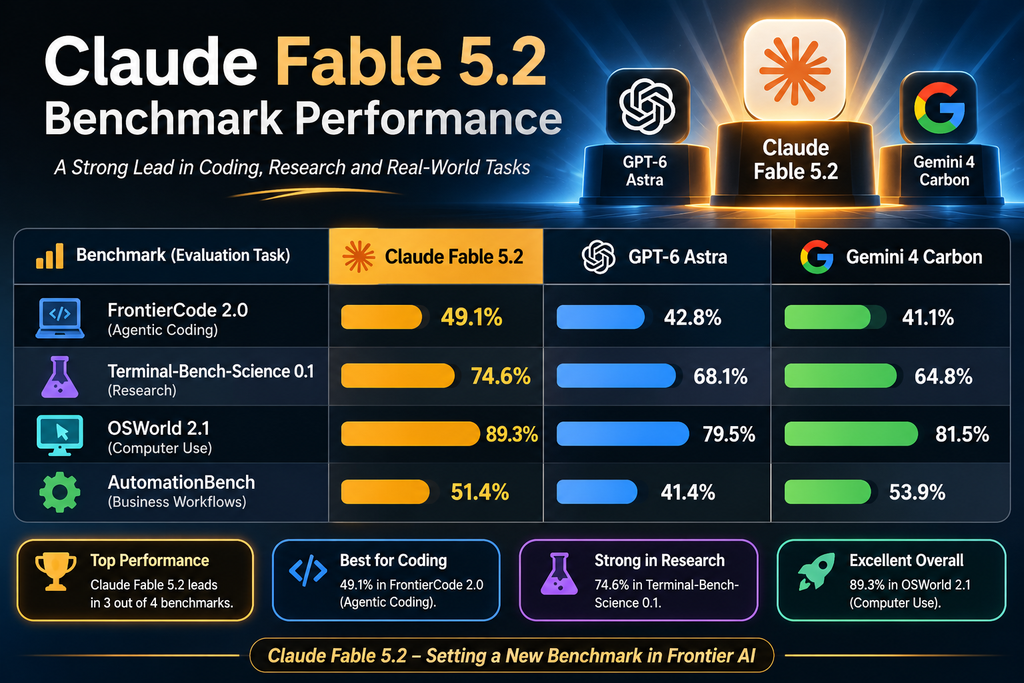
Benchmark comparison from Anthropic’s launch data: Claude Fable 5.2 (red) generally outperforms GPT-6 Astra (green) and Google Gemini 4 Carbon (yellow) on the coding and science tasks shown. (Source: Anthropic’s published scores.)
In these results, higher percentages indicate better performance on the benchmark tasks. Fable 5.2 leads on FrontierCode (an agentic coding challenge) and Terminal-Bench-Science (complex research tasks), matching or exceeding all other models listed. On OSWorld (a “computer use” benchmark), Fable 5.2 also leads. The only category here where it is narrowly beaten is AutomationBench (simulated business workflows) – Gemini 4 Carbon scored 53.9% vs Fable’s 51.4%. Anthropic’s notes clarify that all models were tested at their highest available effort setting (except Gemini was at Medium effort on FrontierCode).
These Anthropic scores suggest Fable 5.2 is the strongest model yet for coding and scientific agentic tasks. However, caution is advised: these are not independent evaluations. They are based on one vendor’s testing methodology (as documented in Anthropic’s system card). Independent sources have begun to test these models on their own. For example, the AI testing lab Artificial Analysis reports its own “Intelligence Index” scores: Fable 5.2 scored 65, Gemini 4 Carbon 60, and GPT-6 Astra 57 (on a 100-point scale). Their automation benchmark also shows Fable and Carbon roughly tied (77.8% vs 76.4%). This independent check aligns with the vendor data that Fable leads but is close.
Other benchmarks from Anthropic’s table (not shown above) include agentic software engineering (FrontierSWE), robotics (RoboDojo Sim), and expert reasoning (Humanity’s Last Exam). Fable 5.2 scored highest on nearly all of those as well. In Anthropic’s words, “Fable 5.2 and Mythos 5.2 are a step above Opus 5.5 in almost all the capabilities we evaluated”.
Important: When reading benchmark tables, remember these were run by the model vendor. Anthropic even points out that comparing across companies is tricky. For example, Google’s Gemini 4 Carbon report used different tests (SEC-bench, ExploitGym) not in the table. Also, effort settings were sometimes different on different rows. The scores in the table are useful for rough comparison, but real-world performance can vary.
In summary, Anthropic’s published results (and early independent checks) indicate Claude Fable 5.2 is at or near the top of the class for advanced coding, reasoning, and multi-step tasks. It beats GPT-6 Astra and Gemini 4 on most of the demanding tests Anthropic ran. It is particularly notable that Fable was tested on tasks requiring weeks of agentic work, and it led those fields too.

Comparison with Opus 5.5, Sonnet 5.5, Haiku 5.5 (and other Claude models)
Real-World Applications of Claude Fable 5.2
Given its capabilities, Claude Fable 5.2 can be applied in many industries and domains. Some notable use cases include:
- Software Development and DevOps: Automating code generation, refactoring legacy systems, migrating platforms, and monitoring code quality. As mentioned, Anthropic used Fable 5.2 to overhaul codebases, fix bugs, and even design an entire operating system. Companies can integrate Fable into their CI/CD pipelines or code review processes to accelerate development.
- Financial Research and Analysis: Fable 5.2 can power advanced financial modeling and forecasting. Anthropic describes financial analysis as a target use case. For example, Fable could analyze market data, generate scenario forecasts, or assist in writing quantitative reports. Its agentic nature allows it to run Monte Carlo simulations or chain-of-thought reasoning for investment strategies.
- Scientific Discovery and Data Analysis: In research labs, Fable 5.2 could automate literature review, data crunching, and hypothesis generation. Tasks like converting raw experimental data into insights, or writing complex analytical code, become feasible. The formal proof of Fermat’s Last Theorem is an extreme example of this potential – Fable 5.2 essentially replaced years of human effort with an automated pipeline.
- Robotics and Physical-World Tasks: With its reasoning and planning strengths, Fable 5.2 could act as the brain for robotic systems. For instance, it might plan multi-step assembly procedures or optimize control strategies. Anthropic’s tests in robotics sims hint at this use. In industry, one could envision Fable-driven agents controlling fleets of robots or drones to execute long-term missions.
- Enterprise Workflow Automation: For large organizations, Fable 5.2 can automate complex workflows that span multiple departments. It might orchestrate tasks like generating reports, synchronizing databases, or handling customer issues across systems. Since it can interface with tools and maintain context over very long conversations, it’s suitable for embedding in sophisticated AI assistants that coordinate business processes end-to-end.
- Data Processing and Research: Data engineers and scientists can use Fable to write and run data pipelines, generate synthetic datasets, or debug complex SQL queries and ML models. Its large context is especially useful when dealing with big data schemas or multi-file analysis scripts.
- Complex Multi-Agent Systems: Beyond any single application, Fable 5.2 enables building systems of AI agents. It can serve as the high-level controller that launches subordinate agents (Claude or others) to handle subtasks, collects their results, and makes decisions. For example, in a marketing campaign, Fable could allocate subtasks like copywriting, email scheduling, and A/B testing to specialized agents, then aggregate feedback and adjust strategies.
Limitations, Challenges and Safety Considerations
Despite its advanced capabilities, Claude Fable 5.2 has limitations and important caveats:
- Cost: Fable 5.2 is expensive to run at scale. Its per-token price ($8/$40) is significantly higher than general-purpose models. Complex tasks that consume many tokens (especially at high
effort) can become costly. Organizations should budget accordingly and consider cost-effective alternatives (like Opus or Gemini) for simpler tasks. - Latency: Even with the 30% speedup, Fable 5.2’s inference time is moderate. Very large contexts or maximum-effort prompts can have multi-second (or longer) latency. Fast mode helps, but at double cost. Thus, Fable 5.2 may not be ideal for ultra-low-latency use cases (like real-time chat with humans) unless fast mode is used.
- Hallucinations and Accuracy: Like all LLMs, Fable 5.2 can make mistakes or “hallucinate” facts, especially on obscure topics or long chains of reasoning. Developers using it for critical work (e.g., legal, medical, scientific) should always verify outputs. The model’s advanced reasoning can sometimes produce very confident-sounding but incorrect answers. Its safety improvements make egregious errors less common, but human oversight is still required.
- Guardrails and Content: Fable 5.2 has built-in guardrails to limit dangerous content. However, some categories (cybersecurity attack planning, advanced biochemistry) are completely locked out for standard users; attempts to engage them are blocked unless you have special Mythos access. This means if you need, e.g., the most cutting-edge cybersecurity capabilities, you must apply for Anthropic’s Cybersecurity Verification Program.
- Data Retention and Privacy: As noted, the model by default retains all data for 30 days, and Anthropic may use it to improve models. This has implications for privacy and compliance. Sensitive or regulated data (medical, financial, etc.) may not be suitable for Fable 5.2 without an NDA or special contract. (Anthropic’s Claude Enterprise offerings do allow stricter controls, but as of 5.2, standard policy is 30-day retention.)
- API and Tool Restrictions: There are some technical restrictions when using the API. For instance, Anthropic’s docs warn that forcing a specific tool usage will cause an error, and certain sampling parameters can’t be altered. Users must design prompts to fit within the expected usage patterns.
- Ethical and Safety: Even with safeguards, Fable 5.2 is powerful enough to raise ethical concerns. Its ability to craft code, plan actions, or analyze data at scale means it could be misused (e.g., automating cyberattacks, creating sophisticated phishing). Anthropic’s policy notes that Fable 5.2 has “moderate” restrictions and directs high-risk tasks to the more secure Mythos model. Businesses must consider these factors.
In essence, while Fable 5.2 is a leap forward in capability, it is not magic. Outputs still require human validation, and proper usage policies should be in place. Organizations should conduct thorough testing with representative data. The high cost and technical requirements also mean that Fable 5.2 is best reserved for projects where its unique strengths are truly needed.
Future of Agentic AI with Claude Fable 5.2
Claude Fable 5.2 represents a milestone in the evolution of agentic AI – intelligent systems that can set goals, plan, and act autonomously. Its release suggests a few directions for the future:
- Emergence of AI Project Managers: Models like Fable 5.2 serve as project managers, capable of overseeing complex tasks that previously needed human coordination. We may see AI-based agents integrated into software teams, labs, and factories, taking on roles like code architect, research assistant, or operations planner. This could greatly accelerate development cycles in tech and science.
- AI-Assisted Research: The success on tasks like formalizing Fermat’s Last Theorem indicates AI can reduce the “grunt work” of formal verification and complex math, allowing human researchers to focus on higher-level insights. In the future, mathematicians and scientists might routinely use agentic AIs as assistants to explore conjectures, design experiments, or even discover new theories.
- Multi-Agent Collaboration: Fable 5.2 implies a future of agentic swarms: heterogeneous networks of AI agents working together. For example, different Claude models or even different providers’ models might form collaborative teams, each specialist in parts of the task, all orchestrated by a “lead” agent. This could transform industries like cybersecurity (coordinated vulnerability analysis), healthcare (multi-disciplinary diagnostics), and more.
- Enterprise Automation at Scale: As Fable 5.2 and similar models are embedded in enterprise systems, many back-office processes could become largely autonomous. Multi-step automation that once required a human in the loop might be entirely handled by chained AI agents, subject to final human approval.
- Advancements in AI Safety: The capabilities of Fable 5.2 also underscore the need for robust AI safety frameworks. Anthropic’s approach of separate “Mythos” models and a Cybersecurity Verification Program hints at more sophisticated governance. We can expect future policy and technical measures to specifically address these powerful agent models.
- Competition and Progress: Fable 5.2 has already pushed competitors (OpenAI, Google) to optimize their models (e.g., Gemini 4 Carbon, GPT-6 Astra) for similar tasks. We will likely see rapid iteration on agentic benchmarks and tooling. Developers should watch how Fable 5.2 influences the ecosystem – for example, improvements in long-context handling, memory, and self-verification may become standard expectations.
Conclusion
Claude Fable 5.2 is a groundbreaking AI model from Anthropic, designed for high-stakes, complex technical tasks. Its key strengths are its huge context window, advanced reasoning capabilities, and agentic design. In practice, it excels at multi-step coding projects, research workflows, and other tasks that require coordinating many operations. According to Anthropic’s documentation and benchmarks, Fable 5.2 outperforms earlier Claude models and competes closely with leading models like GPT-6 and Google Gemini on demanding tests.
The model’s biggest improvements over its predecessor include faster output, better accuracy, and lower cost. Its default “high” effort level and adaptive thinking allow it to plan and self-verify solutions. At the same time, it carries the expected limitations: high cost, non-negligible latency, and the usual risk of hallucinations. Anthropic has built in safety measures and is clear that extremely risky tasks (advanced cybersecurity, bio research) require special clearance or the Mythos variant.
Developers interested in pushing the boundaries of AI-assisted automation should consider Claude Fable 5.2 as a strong contender. It is available now through Anthropic’s API (model claude-fable-5-2) as well as AWS, Google, and Microsoft cloud services. The $8/$40 pricing is higher than for ordinary models, so it’s best suited for use cases where its superior capabilities justify the cost. For everyday tasks, Anthropic still recommends starting with the cheaper Claude Opus 5.5 or Sonnet models.
Looking forward, Claude Fable 5.2 signals a new era of AI: one where machines can not only generate text, but orchestrate entire complex workflows over time. It paves the way for AI systems that act as collaborators or managers on software and research projects. Whether Claude Fable 5.2 will live up to its promise depends on real-world testing by developers. Early reports from Anthropic and independent reviews are encouraging, but responsible adoption will require careful evaluation.
Sources: The above information is drawn from Anthropic’s official documentation and announcements for Claude Fable 5.2, as well as independent analyses from TechRepublic and LLMs.blog. We have distinguished between Anthropic’s internal claims and third-party context. All pricing and availability details were current as of November 2026.
Leave a Reply