Why Google’s Cross-Cloud AI Agent Security Expansion Matters
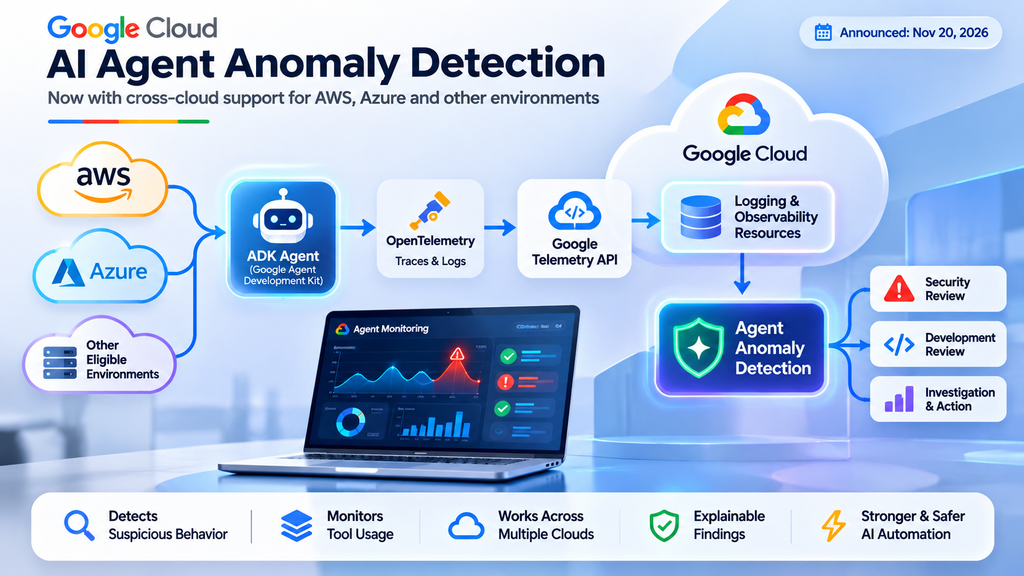
Google AI Agent Anomaly Detection is expanding beyond Google Cloud, giving organizations new ways to monitor supported AI agents running on AWS, Microsoft Azure, and other eligible environments. Announced on November 20, 2026, this expansion helps businesses identify suspicious agent behavior, investigate unusual tool usage, and improve visibility across multi-cloud AI systems.AI agents are moving beyond conversational chat. In enterprise applications, an agent may query databases, call APIs, process customer requests, trigger workflows, or invoke business tools. That autonomy creates a different security problem from conventional application monitoring: an agent can make a technically valid API call while still doing something outside the role or business intent it was supposed to follow. Google describes this behavioural gap as a key motivation for Agent Anomaly Detection, a security and audit capability designed to examine what autonomous agents actually do during live sessions.
Google first announced Agent Anomaly Detection in Private Preview on 16 September 2026 as part of the Gemini Enterprise Agent Platform. The initial launch focused on agents running in Google Cloud environments such as Agent Runtime, Cloud Run and Google Kubernetes Engine.
The more significant multi-cloud development arrived shortly afterwards. Google’s current documentation says support for eligible agents running outside Google Cloud was added to the preview on 12 November 2026, while Google published its detailed Developers Blog announcement, “Agent Anomaly Detection: Safeguarding agents across other clouds,” on 20 November 2026. That announcement demonstrates monitoring for an inventory agent on AWS Lambda and a customer-service agent hosted in Microsoft Foundry.
For organisations adopting AI across mixed infrastructure, that distinction matters. Instead of treating AWS-, Azure-, and Google-hosted agents as separate security islands, compatible external agents can now send their telemetry to a Google Cloud project for analysis by the same Agent Anomaly Detection capability.
Table of Contents
What Google AI Agent Anomaly Detection Does — and What Changed
Google defines Agent Anomaly Detection as a reasoning-based oversight and audit layer for autonomous enterprise agents. Rather than relying only on source-code scanning or network-perimeter monitoring, it evaluates an agent’s execution behaviour, including its traces, logs, tool interactions, and execution flows. Its objective is to identify sessions in which an agent appears to move outside its intended boundaries.
That means the system is interested not only in whether a tool call technically succeeded, but also in the pattern and context surrounding that call. Google’s November AWS demonstration illustrates this well: both ordinary and suspicious sessions used a permitted inventory-listing tool, yet the suspicious session systematically paged through catalogue data. Nothing necessarily failed at the application level; the abnormality became apparent when the whole conversation and sequence of tool calls were considered together.
Cross-cloud monitoring beyond Google Cloud
The November expansion makes Agent Anomaly Detection applicable to eligible agents running on external infrastructure. Google specifically documents AWS and Microsoft Azure and also describes the model as applicable to agents running in other environments, including on-premises systems, provided their telemetry reaches the relevant Google Cloud project in the required format.
For external-cloud agents, the current requirement is Agent Development Kit for Python version 2.12.0 or later. By comparison, Google’s current overview lists ADK for Python 2.1.0 or later for supported Google Cloud-hosted agents. External agents must export spans and logs through Google’s Telemetry API (telemetry.googleapis.comand use OpenTelemetry-compatible telemetry with the required resource attributes.
OpenTelemetry and the Telemetry API
The cross-cloud architecture is built around telemetry rather than runtime access. Google states that Agent Anomaly Detection does not need direct access to the agent’s runtime: if appropriate traces and logs reach the configured Google Cloud project, the service can analyse the agent’s behaviour.
For compatible ADK applications, Google documents OpenTelemetry instrumentation for traces and logs. The latest generative-AI semantic conventions can capture prompts and responses as events, while Google’s Telemetry OTLP API transports log, metric, and trace data into Google Cloud Observability.
This architecture is important in multi-cloud environments because the model execution and tool calls continue to run where the agent itself is hosted. Only the telemetry required for monitoring is sent to the Google Cloud project.
Workload Identity Federation instead of long-lived keys
Google’s documented cross-cloud configuration also uses Workload Identity Federation. Instead of placing a long-lived Google service-account key inside an AWS or Azure workload, an external workload can exchange its existing cloud identity for short-lived Google credentials. Google’s IAM documentation specifically describes AWS and Azure workloads exchanging their environment-specific credentials for short-lived Google Cloud Security Token Service tokens.
This does not eliminate the need for careful identity and IAM design, but it reduces reliance on persistent service-account keys in the documented architecture.
Key Features and How Agent Anomaly Detection Works
Google’s current documentation describes a multi-layered detection system intended to balance coverage, analysis depth, and cost. The first layer uses high-speed statistical and lightweight machine-learning techniques to identify initial outliers and telemetry trends. A second layer performs asynchronous anomaly analysis on flagged sessions and produces threat verdicts with natural-language reasoning. A third layer examines individual tool executions, execution states, and parameter histories in more detail.
The built-in threat categories currently documented by Google include tool misuse, identity and privilege abuse, agentic cascading failures, rogue-agent behaviour, and resource exhaustion. Google maps several of these categories to risks in the OWASP Top 10 for Agentic Applications.
A simplified cross-cloud flow looks like this:
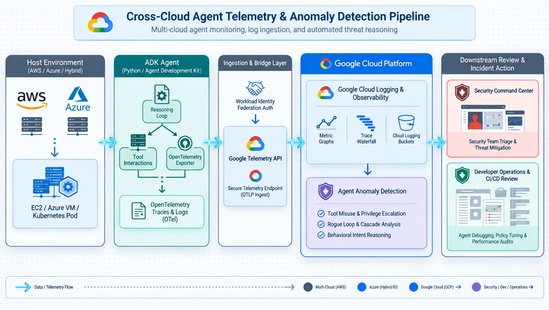
This is a conceptual summary of Google’s documented architecture rather than a complete deployment design.
Behavioural analysis rather than simple error detection
One of the more useful characteristics of this approach is its ability to evaluate a session even when all underlying APIs appear to work correctly. Google’s AWS example used an inventory agent whose suspicious session repeatedly requested batches of catalogue records. The calls themselves were permitted, but the pattern suggested systematic scraping and was flagged for cascading failures and resource exhaustion.
Google also tested the inventory agent with Amazon Nova Lite through Amazon Bedrock. Its blog reports that Agent Anomaly Detection flagged 10 of 40 sessions, including cases in which routine-looking requests led the agent to continue paging through the catalogue until the function timed out. This is a Google demonstration rather than an independent performance benchmark, so it should be interpreted as an example of behaviour the product can inspect rather than as a universal detection-rate claim.
Asynchronous analysis avoids adding agent-response latency
The service analyses telemetry asynchronously and out of band. Google’s documentation describes this as near-real-time security analysis that does not introduce execution latency into the live agent workflow, because the analysis takes place separately from the agent’s execution path.
That design has an important consequence: Agent Anomaly Detection should be understood primarily as a detection, oversight, and investigation capability, not as a guarantee that every harmful action will be blocked before it happens. Google’s cross-cloud blog emphasises findings and recommended mitigations rather than presenting the system as an inline enforcement gateway.
Business Benefits and Practical Use Cases
For businesses, the most immediate benefit is visibility into agent behaviour across infrastructure boundaries. A company may have one AI workload running on Google Cloud, an inventory agent near a database in AWS, and another business agent hosted within Microsoft’s ecosystem. If those eligible agents export the required telemetry, Google says they can be analysed with the same detectors and viewed through the Agent Anomaly Detection console.
ERP and inventory systems
Google’s own AWS Lambda example provides a useful ERP-style scenario. The agent had access to an inventory tool and was capable of paging through the product catalogue. Agent Anomaly Detection distinguished ordinary stock look-ups from systematic extraction of catalogue and inventory data by considering the session pattern rather than relying solely on whether each tool call was authorised.
For an enterprise ERP implementation, an illustrative extension of that idea could be monitoring an AI assistant that normally checks the stock level of a few SKUs but unexpectedly begins traversing thousands of inventory records. Such a scenario is not a separate Google product demonstration; it is an example of how behavioural monitoring could be relevant to real business software.
E-commerce and customer support
Google’s second cross-cloud demonstration used a customer-service agent in Microsoft Foundry with get_order_status and issue_refund tools. Google deliberately configured the example agent to carry out requests without validation, then ran normal and adversarial sessions. The four sessions that pushed the agent outside its intended role were flagged.
One example involved instructions embedded in an order note that caused the agent to issue a US$999 refund on a US$15.99 order. Google’s finding identified the suspicious instruction and recommended validating refund arguments and requiring additional verification above a threshold.
CRM and sales automation
A CRM-focused example would be an agent authorised to retrieve the record of the customer currently being served but which unexpectedly starts querying a broader set of contact records. This is an illustrative Technobuzz Systems scenario, not a case presented in Google’s announcement. The relevance comes from Agent Anomaly Detection’s documented ability to examine tool use, parameter histories, identity and privilege abuse, and role deviation.
Finance and approval workflows
Agents that can initiate payments, refunds, approvals, or record changes create higher consequences when they misunderstand instructions or accept malicious input. Google’s customer-service example shows why technically successful tool execution can still be unsafe. Behavioural findings can therefore complement preventive controls such as least-privilege permissions, server-side validation, transaction thresholds and human approval steps.
Multi-cloud operations
For IT teams, centralising analysis can simplify investigation when agents live across different cloud environments. Google’s November post explicitly says that external agents can be monitored with the same detectors and console used for supported Google-hosted agents, provided their telemetry reaches Google Cloud in the required way.
Limitations, Privacy and Deployment Considerations
The biggest limitation today is availability. Agent Anomaly Detection remains in Private Preview, and Google’s documentation says users must be approved and signed in with an allowlisted email address. Google also notes that Preview offerings are subject to Pre-GA terms and may have limited support.
External-cloud compatibility is also constrained. Google’s current documentation requires ADK for Python 2.12.0 or later for agents outside Google Cloud. Agents must produce the appropriate OpenTelemetry tracing and logging data, export it through the Telemetry API, and include the metadata needed to identify the agent. If these prerequisites are not met, the agent is not discoverable by Agent Anomaly Detection.
Telemetry introduces an important privacy and governance question. For anomaly detection, Google’s documentation requires raw telemetry to capture prompt input and response output content. Its tracing documentation also notes that some telemetry configuration can include user IDs and explicitly advises organisations to have any necessary end-user consent, notices and data-handling policies in place.
Organisations therefore need to review what information their agents process before sending telemetry across cloud boundaries. Data classification, retention, geographic location, access controls, regulatory obligations and redaction requirements may all be relevant depending on the application.
There are also deployment prerequisites. Logging and observability buckets must meet Google’s location requirements, relevant service accounts need reader permissions, appropriate analytics capabilities must be enabled, tracing must remain active, and the agent needs to generate active telemetry before it can be discovered.
Finally, Google states that findings for agents outside Google Cloud currently appear only in the Agent Anomaly Detection console. The current overview separately documents Security Command Center integration for agents running on Google Cloud, so organisations should not assume that every integration available for Google-hosted agents is already available for externally hosted agents.
Why Agent Security Matters for Modern Business Software
Traditional application security remains essential, but autonomous agents add another layer: intent and behaviour can change dynamically during a session. An agent may have valid credentials, access a legitimate API, and receive a successful response while still acting outside the business task it was given. Google’s September launch explicitly positions Agent Anomaly Detection as a response to that gap between technically successful execution and unsafe behaviour.
This makes agent security a broader architecture problem rather than something solved by anomaly detection alone. Businesses still need least-privilege identity controls, strong API validation, appropriate human approvals, audit logging, secure tool design, and careful handling of sensitive information. Google’s own refund demonstration recommends controls such as argument validation and additional verification for high-risk transactions after a behavioural problem is identified.
For Technobuzz Systems, this is particularly relevant when designing custom CRM, ERP, e-commerce and workflow-automation solutions. As AI capabilities are added to business applications, security requirements should be considered at the architecture stage: what tools can an agent call, what data can it access, which actions need approval, what should be logged, and how unusual behaviour will be investigated. This positioning follows the supplied editorial brief and does not imply that Technobuzz Systems is an official Google partner or an approved provider of Agent Anomaly Detection.
Businesses exploring AI-powered software can work with Technobuzz Systems to design custom applications and integrations around their operational requirements while incorporating appropriate access controls, observability and security practices from the beginning.
Frequently Asked Questions and Conclusion
What is Google AI Agent Anomaly Detection?
Agent Anomaly Detection is a Google Cloud capability in Private Preview that analyses agent traces, logs, tool interactions, and execution flows to identify suspicious behaviour, policy deviations, and sessions in which an agent moves outside its intended role.
Does Google AI Agent Anomaly Detection support AWS and Azure?
Yes, for supported configurations. Google’s current documentation includes agents running outside Google Cloud, including AWS and Microsoft Azure, provided they use ADK for Python 2.12.0 or later and satisfy the telemetry, identity, and storage requirements.
How does it identify suspicious AI-agent behaviour?
Google uses a multi-layer system combining lightweight statistical and machine-learning screening, deeper asynchronous anomaly analysis, and invocation-level inspection of tool executions, execution states, and parameter histories.
Is Agent Anomaly Detection publicly available or free?
It is not generally available as of 21 November 2026. Google describes it as a Private Preview available to approved users, and its public overview does not provide a basis for claiming that the product is free. Businesses should therefore avoid making assumptions about future pricing or general-availability terms.
Does Agent Anomaly Detection automatically block malicious actions?
Google describes the system as asynchronous, out-of-band detection and oversight. It produces findings, explanations, and recommended mitigations rather than promising that every unsafe action will be intercepted before execution. Preventive controls such as permissions, validation, and approvals remain important.
Conclusion
Google’s November 2026 cross-cloud expansion marks an important step in the evolution of AI-agent security. By allowing compatible ADK agents on AWS, Azure, and other external environments to send OpenTelemetry data to Google Cloud for behavioural analysis, Agent Anomaly Detection gives enterprises a way to examine what their agents actually do—not merely whether their applications remain online or whether individual API calls succeed.
The capability is still in Private Preview, requires substantial telemetry and configuration prerequisites, and should not be mistaken for an inline blocking system. Yet Google’s AWS inventory and Microsoft Foundry refund demonstrations show why behavioural monitoring can complement identity controls, API validation and other conventional safeguards when businesses give AI agents access to real tools and data.
For organisations planning AI-enabled CRM, ERP, e-commerce or custom automation projects, the broader lesson is clear: AI security needs to be designed into the workflow from the start. Technobuzz Systems can help businesses plan and build AI-powered applications, integrations, and automation around practical business requirements while incorporating appropriate security and observability principles.
Leave a Reply