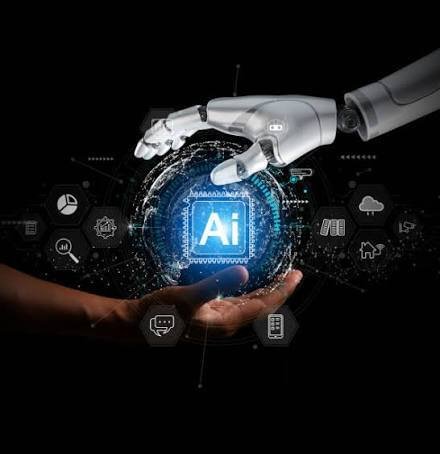
AI INNOVATIONS • 2026
The Future of AI Is Already Here
Artificial Intelligence is transforming the way we communicate, work, learn, shop, and interact with technology. Discover how AI is shaping everyday life today—and what the future may bring.
EXPLORE THE FUTURE OF AI
Contact Us
Artificial Intelligence is no longer just a concept from science-fiction movies. It has quietly become part of the way we communicate, work, shop, travel, learn, and access services.
From voice assistants and personalized recommendations to AI-powered healthcare tools and coding assistants, artificial intelligence is already influencing everyday decisions. At the same time, new developments such as generative AI, multimodal systems, AI agents, robotics, edge AI, and AI-powered scientific research are opening the door to an even more connected future.
So, what does the future of AI actually look like?
In this article, we explore how AI is being used today, the latest AI innovations, the technologies that could shape the coming years, and how individuals and businesses can prepare for an increasingly AI-powered world.
AI in Everyday Life: How Artificial Intelligence Powers Our Daily Activities
Many people use AI every day without realizing it. Artificial intelligence works behind many of the digital services and devices we depend on.
Smartphones and Personal Devices
Modern smartphones include several AI-powered features.
Voice assistants can understand spoken commands, predictive keyboards can suggest the next word, and smartphone cameras can automatically recognize scenes and improve images.
AI is also used in features such as:
- Face recognition
- Voice-to-text conversion
- Predictive typing
- Image enhancement
- Personalized notifications
- Language translation
- Mobile security
Fitness trackers and smartwatches can also analyze activity, sleep, heart rate, and other patterns to provide personalized insights.
Search, Shopping and Online Services
AI has transformed the way people search for information online.
Search engines use sophisticated algorithms to understand queries and deliver relevant results. E-commerce platforms use recommendation systems to suggest products based on browsing behavior, previous purchases, and interests.
AI is also used to detect unusual transactions, identify spam, personalize advertisements, and improve customer experiences.
Social Media and Entertainment
Social media platforms use AI to determine which content may be relevant to individual users.
AI can analyze interactions such as likes, searches, shares, and viewing behavior to personalize content feeds.
Entertainment platforms also use recommendation systems to suggest movies, music, videos, and other content based on user preferences.
This is one of the most visible examples of everyday AI uses.
Smart Homes and Education
AI is also entering homes and learning environments.
Smart home devices can learn patterns and automate certain activities. Voice assistants can answer questions, control compatible devices, create reminders, and perform other tasks.
In education, AI can support personalized learning by helping students understand concepts, generate practice questions, receive feedback, and discover learning resources.
Healthcare and Wellness
Healthcare is another important area where AI innovation is developing rapidly.
AI systems can assist professionals in analyzing medical images, organizing information, identifying patterns, and supporting research.
Wearable devices can also analyze health and activity data to provide users with insights about their daily habits.
However, healthcare AI requires careful validation, privacy protection, and human oversight because medical decisions can have significant consequences.
AI at Work: Building Smarter Businesses
AI is changing not only how people use technology but also how businesses operate.
Organizations are increasingly using AI to automate repetitive processes, analyze information, communicate with customers, and support employees.
Automation and Productivity
One of the biggest benefits of AI is its ability to assist with repetitive tasks.
Businesses can use AI for activities such as:
- Data analysis
- Document processing
- Email assistance
- Report generation
- Customer support
- Software development
- Marketing analysis
- Forecasting
AI coding assistants can help developers understand code, generate routine code, identify potential issues, and accelerate development workflows.
The important shift is that AI does not necessarily have to replace an entire job. In many situations, it can automate individual tasks within a job and allow people to spend more time on problem-solving, creativity, and decision-making.
Customer Experience
AI-powered chatbots and virtual assistants are becoming common across websites and applications.
Instead of waiting for a human representative for every basic question, customers can receive immediate assistance for common requests.
Businesses can also use AI-powered recommendation systems to personalize products, services, and marketing messages.
AI Across Industries
AI innovation is being applied across many industries.
In finance, AI can help identify unusual transaction patterns.
In manufacturing, computer vision can assist with quality inspection.
In logistics, AI can support route planning and demand forecasting.
In marketing, AI can help analyze audiences and generate content ideas.
In software development, AI assistants can support developers throughout the coding process.
These applications demonstrate how AI is becoming a general-purpose technology rather than a tool limited to one particular industry.
The Rise of Generative AI and AI Agents
One of the most significant developments in recent years has been generative AI.
What Is Generative AI?
Generative AI refers to systems that can create new content based on user instructions.
Depending on the system, this can include:
- Text
- Images
- Code
- Audio
- Video
- Summaries
- Ideas and drafts
Instead of simply searching for existing information, generative AI can produce new outputs based on patterns learned during training.
This has created new possibilities for developers, designers, marketers, students, researchers, and businesses.
Multimodal AI
Another important development is multimodal AI.
Traditional AI applications may focus primarily on one type of input, such as text or images. Multimodal systems can work with different forms of information, including text, images, audio, and other data.
For example, a user may provide an image and ask an AI system to explain what it contains.
This makes interactions with AI more natural and useful for real-world situations.
AI Agents
AI agents represent another major direction in AI innovation.
A traditional chatbot generally responds to a user’s question. An AI agent can go further by planning a sequence of actions and using available tools to accomplish a larger goal.
For example, an AI agent could potentially:
- Understand a user’s objective.
- Break the objective into smaller tasks.
- Collect relevant information.
- Use software tools.
- Evaluate results.
- Continue working until the task is completed.
This could eventually change how businesses handle research, customer service, administration, software development, and other workflows.
Human supervision will remain important, particularly when agents are performing actions that involve sensitive information, money, security, or important decisions.
Future AI Technologies to Watch
The future of AI is likely to involve several technologies developing at the same time.
Next-Generation AI Models
AI models are becoming increasingly capable of understanding different types of information and handling more complex tasks.
Future systems may provide more accurate reasoning, better context handling, improved personalization, and stronger integration with software tools.
AI Robotics and Autonomous Systems
Robotics is another area where AI could have a major impact.
AI-powered robots can combine perception, decision-making, movement, and learning to perform tasks in controlled environments.
Potential applications include:
- Manufacturing
- Warehousing
- Healthcare assistance
- Delivery
- Agriculture
- Inspection
- Household assistance
The speed of adoption will depend on technical progress, cost, safety, regulation, and public acceptance.
AI in Healthcare and Scientific Research
AI can also accelerate scientific discovery.
Researchers are exploring AI for areas such as drug discovery, medical imaging, protein research, and personalized treatment.
Rather than replacing scientists or doctors, these systems can serve as tools that help professionals analyze large amounts of information and identify patterns.
Edge AI and IoT
Edge AI means processing AI workloads closer to where data is generated instead of sending everything to a remote cloud server.
This can be useful for smartphones, cameras, wearable devices, industrial equipment, and IoT systems.
Potential benefits include faster response times, reduced dependence on connectivity, and greater control over certain types of data.
Quantum Computing and AI
Quantum computing is still an emerging field, but researchers are investigating how quantum technologies could eventually work alongside AI.
Possible applications include optimization, scientific simulation, materials research, and other computationally demanding problems.
However, practical large-scale quantum-AI applications remain an area of active research rather than an established everyday technology.
Will AI Replace Human Workers?
One of the biggest questions surrounding the future of AI is employment.
AI is likely to automate some repetitive tasks while changing the responsibilities associated with many existing jobs.
For example, an employee who previously spent hours preparing routine reports may increasingly use AI to generate a first draft and spend more time reviewing information, making decisions, and communicating results.
This means the important question may not simply be whether AI will replace jobs.
A more useful question is:
How will AI change the tasks people perform within their jobs?
Skills such as critical thinking, communication, creativity, domain knowledge, problem-solving, and the ability to work effectively with technology are likely to remain important.
AI literacy will also become increasingly valuable across technical and non-technical roles.
Challenges and Ethical Considerations
The development of AI also brings important challenges.
Bias and Fairness
AI systems learn from data. If the underlying data contains biases, an AI system may reproduce or amplify them.
Organizations therefore need appropriate testing and monitoring when AI is used for important decisions.
Privacy
AI applications can process large amounts of information.
Businesses need to understand what information their AI systems collect, where it is stored, how it is processed, and who can access it.
Security
AI can be used for beneficial purposes, but it can also introduce new security risks.
Organizations need to consider threats such as malicious use, manipulated content, automated attacks, and attempts to exploit AI systems.
Transparency and Accountability
When AI contributes to an important decision, organizations need clear processes for understanding how the system is being used and who remains responsible for the final outcome.
For high-impact applications, human oversight is especially important.
Job Disruption
AI adoption can change existing roles and create demand for new skills.
Organizations, educational institutions, and professionals will need to focus on continuous learning and reskilling as technology develops.
How to Prepare for an AI-Powered Future
AI is developing quickly, so preparing for the future starts with understanding how the technology can be used responsibly today.
1. Learn AI Fundamentals
You do not need to become an AI researcher to understand artificial intelligence.
Start with basic concepts such as:
- Machine learning
- Generative AI
- Large language models
- Computer vision
- Natural language processing
- AI agents
2. Experiment With AI Tools
Try AI tools for practical tasks such as research, writing, coding, brainstorming, data analysis, and productivity.
The goal should be to understand both what AI can do and where human judgment is still necessary.
3. Develop Human Skills
Technical knowledge is important, but human skills remain valuable.
Focus on:
- Critical thinking
- Creativity
- Communication
- Problem-solving
- Collaboration
- Decision-making
4. Businesses Should Start With Practical Use Cases
Companies do not need to transform everything at once.
A better approach is to identify one repetitive or time-consuming process, test an AI solution, measure the results, and then decide whether the solution should be expanded.
5. Build Responsible AI Practices
Organizations using AI should consider privacy, security, fairness, transparency, and human oversight from the beginning.
Responsible implementation can help businesses gain the benefits of AI while reducing unnecessary risks.
Conclusion: The Future of AI Is Already Beginning
Artificial intelligence is no longer a distant future technology.
It is already present in smartphones, search engines, online shopping, entertainment, healthcare tools, business software, and development platforms.
The next phase of AI will likely focus on more capable generative models, multimodal systems, AI agents, robotics, edge computing, scientific applications, and new forms of human-AI collaboration.
For individuals, the opportunity is to learn how to work effectively with AI.
For businesses, the opportunity is to identify practical applications that improve productivity, customer experience, and innovation.
The future of AI will not be defined only by the technology itself. It will also depend on how responsibly people and organizations choose to use it.
Frequently Asked Questions
What are some everyday examples of AI?
Examples include voice assistants, search engines, recommendation systems, spam filters, navigation applications, smart cameras, translation tools, and AI-powered chatbots.
What is the difference between generative AI and traditional AI?
Traditional AI systems are often designed to recognize patterns, make predictions, or perform specific tasks. Generative AI can create new content such as text, images, audio, code, and other outputs.
What are AI agents?
AI agents are systems designed to understand objectives, plan steps, use tools, and perform multiple actions to complete a task.
Will AI replace all human jobs?
AI may automate certain tasks and change many jobs, but the impact will vary by industry and occupation. Human judgment, creativity, communication, and domain expertise will continue to be important.
What AI technologies should businesses watch?
Businesses should pay attention to generative AI, AI agents, multimodal AI, AI-powered automation, edge AI, robotics, and AI applications in data analysis and customer service.
How can I prepare for the future of AI?
Start by learning AI fundamentals, experimenting with useful AI tools, improving digital skills, developing critical thinking and communication abilities, and staying informed about responsible AI practices.
Final Takeaway
AI is evolving from a technology that simply answers questions into systems that can understand different forms of information, generate content, use tools, and assist with increasingly complex workflows.
The organizations and individuals who understand both the opportunities and limitations of AI will be better prepared to adapt as the technology continues to evolve.
Want to explore how AI can improve your business? Contact Technobuzz Systems to discuss technology solutions, automation, and AI-powered opportunities for your organization.
Leave a Reply