New Innovations in .NET: What Developers Need to Know in 2026
Last Updated: October 2, 2026
Category: Technology / .NET Development
Reading Time: 7–9 minutes
Introduction
The new innovations in .NET are changing how developers build modern web applications, APIs, cloud-native systems and AI-powered software.
The .NET ecosystem has changed significantly in recent years. What started primarily as a framework for building enterprise applications has evolved into a broader development platform for web applications, APIs, cloud-native systems, high-performance services, AI-enabled applications, and modern distributed solutions.
In 2026, .NET 10 is the current active Long-Term Support (LTS) release, making it an important version for businesses and developers building production applications. At the same time, .NET 11 Release Candidate 1 provides a preview of where the platform is heading, particularly toward artificial intelligence, agentic applications, cloud-native development, and improved developer productivity. dotnet_latest_innovations_2026_…
So, what exactly is changing?
Let’s explore the major innovations shaping modern .NET development in 2026.
1. New Innovations in .NET 2026: .NET 10 Becomes the New LTS Foundation
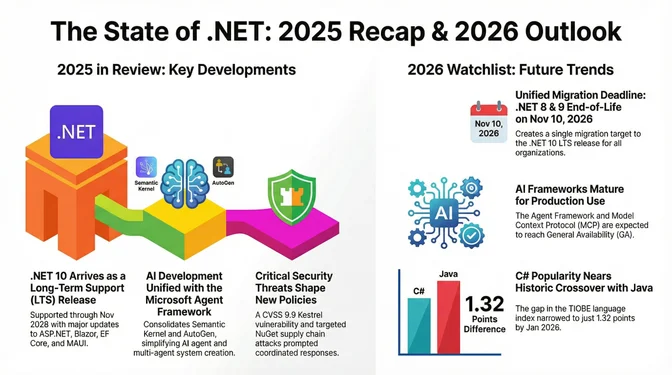
One of the biggest developments is the arrival of .NET 10, released on November 11, 2025.
.NET 10 is an LTS release and is currently the primary stable version to consider for new production-focused applications. According to the Microsoft support information referenced in the research guide, .NET 10 is supported through November 14, 2028. dotnet_latest_innovations_2026_…
This makes .NET 10 particularly relevant for organizations that want a stable development platform for applications expected to remain in production for several years.
Developers can use it for:
- Enterprise applications
- REST APIs
- Web applications
- Microservices
- Cloud-native applications
- Database-driven systems
- AI-enabled applications
- High-performance backend services
The transition from .NET 8 and .NET 9 toward .NET 10 also demonstrates Microsoft’s continued focus on performance, security, cloud development and developer productivity. dotnet_latest_innovations_2026_…
2. Faster Applications with .NET 10 Runtime Improvements
Performance is one of the most important areas of innovation in .NET 10.
Modern applications often process thousands or millions of requests, making efficient CPU and memory usage increasingly important.
.NET 10 introduces improvements to the runtime and compiler that allow applications to make better use of modern hardware.
Some important areas include:
Improved JIT Optimization
The Just-In-Time (JIT) compiler has received improvements that can make better optimization decisions when compiling application code.
One area is JIT inlining, where suitable method calls can be optimized to reduce unnecessary overhead.
Better Method Devirtualization
.NET 10 provides additional opportunities to optimize virtual and interface method calls.
This can help applications where such calls occur frequently.
Improved Stack Allocation
The runtime also improves how suitable temporary data can be handled, potentially reducing unnecessary memory-related overhead in appropriate scenarios.
Modern CPU Support
.NET 10 includes support for newer CPU vector capabilities such as AVX10.2, helping applications take advantage of modern hardware capabilities.
Native AOT Improvements
Native AOT continues to receive investment, allowing suitable .NET applications to be compiled ahead of time rather than relying entirely on runtime compilation.
These changes are particularly interesting for high-performance APIs, backend services and applications running in resource-sensitive environments. dotnet_latest_innovations_2026_…
3. C# 14 Makes Development More Flexible
.NET 10 also arrives with C# 14, introducing language improvements designed to make everyday coding cleaner and more expressive.
Some of the notable additions include:
- Field-backed properties
- Extension blocks
- Null-conditional assignment
- Improved Span conversions
- Better
nameofsupport - More flexible lambda parameter modifiers
- Partial constructors and events
- Custom compound and increment/decrement operators dotnet_latest_innovations_2026_…
For developers, these features are not simply about adding more syntax to the language. The broader objective is to make common programming tasks easier to express while giving developers more flexibility when designing applications and libraries.
For example, developers working on large applications can benefit from cleaner property implementations and improved extension capabilities.
4. ASP.NET Core 10 Brings Modern Web Development Features
For web developers, ASP.NET Core 10 is another major part of the .NET 10 ecosystem.
It introduces improvements across authentication, APIs, OpenAPI, Blazor and application performance.
Passkeys and WebAuthn
One particularly important security innovation is support for passkeys/WebAuthn in ASP.NET Core Identity.
Instead of relying entirely on traditional passwords, passkeys use public-key cryptography to provide passwordless authentication.
This can help developers build authentication systems that are more resistant to phishing attacks.
For applications handling sensitive information, modern authentication methods are becoming increasingly important. dotnet_latest_innovations_2026_…
Minimal API Validation
Minimal APIs are popular for building lightweight services and microservices.
.NET 10 adds validation capabilities for data such as:
- Query parameters
- Request headers
- Request bodies
This allows developers to build cleaner APIs while keeping validation closer to the API endpoint design. dotnet_latest_innovations_2026_…
Better OpenAPI Support
API documentation is an important part of modern software development.
.NET 10 improves OpenAPI support, including support within Native AOT Web API templates and access to OpenAPI documents through dependency injection.
This can make API development and documentation workflows more integrated. dotnet_latest_innovations_2026_…
5. Blazor Continues to Evolve
Blazor remains an important technology for developers who want to build interactive web interfaces using .NET and C#.
.NET 10 introduces improvements including:
- WebAssembly preloading
- Asset fingerprinting
- Circuit state persistence
Circuit state persistence is particularly useful for applications where server-side connections can temporarily disappear or become interrupted.
These improvements are aimed at improving application startup, static asset management and resilience. dotnet_latest_innovations_2026_…
6. JSON Processing Gets More Powerful
Modern applications exchange huge amounts of data through JSON APIs.
.NET 10 continues to improve System.Text.Json.
The improvements include areas such as:
- JSON Patch
- Duplicate-property handling
- Serialization settings
PipeReadersupport
The .NET 10 JSON Patch implementation is designed around modern .NET serialization and focuses on reducing allocations and improving performance in Microsoft’s documented benchmark scenarios. dotnet_latest_innovations_2026_…
This matters because efficient serialization and deserialization can have a significant impact on API-heavy applications.
7. Security Becomes a Bigger Part of .NET Innovation
Security is no longer something that should be added after an application is built.
Modern applications need security throughout the development lifecycle.
.NET 10 expands capabilities in areas such as cryptography, authentication and networking.
One notable area is the expansion of support for post-quantum cryptography, including additional Windows CNG support and improvements related to ML-DSA.
The platform also includes support for technologies such as:
- AES KeyWrap with Padding
- TLS 1.3 support for macOS clients
- Improved WebSocket capabilities
- Additional diagnostics and process-management capabilities dotnet_latest_innovations_2026_…
As computing technology evolves, cryptographic systems also need to evolve. This makes the continued development of security features an important part of the .NET roadmap.
8. EF Core 10 Improves Database Development
Applications are only as useful as the data behind them.
Entity Framework Core 10 continues to improve the experience of working with databases from .NET applications.
Some highlighted areas include:
Better LINQ Capabilities
Developers can use LINQ to express more sophisticated database queries from application code.
Performance Improvements
EF Core 10 includes optimizations aimed at improving data-access workloads.
Azure Cosmos DB Improvements
The Cosmos DB provider also receives improvements.
Named Query Filters
Named query filters allow applications to define multiple filters for an entity and selectively disable them when required.
This can make database access easier to organize in larger applications. dotnet_latest_innovations_2026_…
For enterprise systems such as ERP, HRMS, payroll, e-commerce and CRM applications, these improvements can be particularly useful because such systems usually contain complex data models and business rules.
9. Native AOT Is Becoming More Important
Another important direction in modern .NET development is Native AOT (Ahead-of-Time compilation).
Traditionally, applications depend heavily on runtime compilation. Native AOT provides a different approach by compiling applications ahead of time.
This can be useful for suitable applications where developers want characteristics such as:
- Faster startup
- Smaller deployment requirements
- Efficient resource usage
- Container-friendly deployments
.NET 10 continues to improve Native AOT, including its integration with Web API templates and file-based applications. dotnet_latest_innovations_2026_… dotnet_latest_innovations_2026_…
However, Native AOT is not automatically the right choice for every .NET application. Developers should evaluate application requirements, dependencies and compatibility before adopting it.
10. .NET CLI and Developer Productivity Improvements
Modern development isn’t only about runtime performance.
Developer tools also have a major impact on productivity.
.NET 10 includes several improvements to the SDK and command-line experience.
These include:
dotnet testsupport for Microsoft.Testing.Platform- Improved CLI command organization
- Native tab-completion scripts
- Native container-image creation for console applications
dotnet tool execdnxtool execution- CLI introspection using
--cli-schema - Improvements for file-based applications
- Native AOT publishing support dotnet_latest_innovations_2026_…
These changes can simplify workflows for developers who frequently work with the command line, containers and automated development environments.
11. .NET and Cloud-Native Development
Modern software is increasingly distributed.
Instead of building one large application, organizations often use:
APIs + microservices + databases + messaging + containers + cloud infrastructure
This creates new development and operational challenges.
The .NET ecosystem is increasingly focused on cloud-native development and distributed applications.
Microsoft’s broader direction includes Aspire, which helps developers work with distributed .NET applications and their supporting services.
This is especially relevant for applications that need multiple components to communicate reliably while remaining observable and manageable. dotnet_latest_innovations_2026_…
12. AI Is Becoming Part of the .NET Ecosystem
Perhaps the most interesting change is the growing connection between .NET and artificial intelligence.
AI is moving beyond standalone chat applications.
Developers are now building applications that can:
- Interact with AI models
- Retrieve information from business data
- Call external tools
- Automate workflows
- Generate content
- Assist users with business processes
The .NET ecosystem is developing capabilities for integrating AI models into C# applications and building applications around agent-like patterns. dotnet_latest_innovations_2026_…
13. RAG Applications with .NET
One important AI application pattern is Retrieval-Augmented Generation (RAG).
Instead of asking an AI model to answer solely from its existing knowledge, a RAG application can retrieve relevant information from a company’s own data before generating an answer.
For example, a company could build an internal assistant that retrieves information from:
- Product documentation
- HR policies
- Technical documentation
- Customer information
- Company knowledge bases
The AI can then use the retrieved information to produce a more context-aware response.
For software companies, this creates opportunities to combine existing .NET applications and databases with modern AI capabilities.
14. The Rise of Agentic Applications
Another emerging direction is agentic application development.
An AI-enabled application can potentially do more than generate text.
It can be designed to interact with tools and services to complete multi-step tasks.
For example:
User Request
     ↓
AI Application
     ↓
Understand the task
     ↓
Call required tools/services
     ↓
Retrieve information
     ↓
Process the result
     ↓
Return response/action
The .NET 11 direction includes work around AI building blocks and agentic-web capabilities in ASP.NET Core and Blazor. dotnet_latest_innovations_2026_…
Because .NET 11 is still in the Release Candidate stage as of October 2, 2026, these capabilities should be treated as upcoming/pre-release, not as stable production features. dotnet_latest_innovations_2026_…
15. Local and On-Device AI
AI applications do not always need to send every task to a remote cloud model.
The .NET ecosystem is also moving toward local and on-device AI scenarios, including directions involving .NET MAUI.
This could be useful for applications where developers need to consider:
- Privacy
- Offline functionality
- Reduced network dependency
- Response latency
- Local processing
The .NET 11 direction includes further exploration of local/on-device AI scenarios across supported .NET MAUI workloads. dotnet_latest_innovations_2026_…
16. Observability for AI Applications
As AI becomes part of production applications, simply knowing whether an application is running isn’t enough.
Developers may also need visibility into:
- AI model calls
- Tool calls
- Response latency
- Token usage
- Failures
- External service dependencies
This makes observability increasingly important for AI-powered applications.
For example, if an AI assistant suddenly becomes slow, developers should be able to determine whether the problem comes from the application, database, external API, AI model or another service.
The .NET AI/cloud-native direction therefore increasingly connects AI integration with distributed application observability. dotnet_latest_innovations_2026_…
.NET 10 vs .NET 11: What’s the Difference?
| Area | .NET 10 | .NET 11 |
|---|---|---|
| Status | Current LTS | Release Candidate |
| Production use | Stable LTS platform | Pre-release |
| Runtime | Performance improvements | Continuing evolution |
| C# | C# 14 | Upcoming language evolution |
| Web | ASP.NET Core 10 | Further web capabilities |
| AI | AI integration direction | Stronger AI/agentic direction |
| Cloud | Cloud-native support | Deeper distributed/cloud integration |
| Recommendation for article | Current platform | Future direction |
The important point is that .NET 10 and .NET 11 should not be presented as equivalent stable releases. As of October 2, 2026, .NET 10 is the active LTS platform, while .NET 11 is still pre-release. dotnet_latest_innovations_2026_…
Why These Innovations Matter for Businesses
These changes are not only relevant to developers.
Businesses can benefit from the broader evolution of .NET through:
Better Application Performance
Runtime improvements can help suitable applications use computing resources more efficiently.
Stronger Security
Passkeys, modern cryptography and networking improvements provide developers with more modern security capabilities.
Faster API Development
Minimal APIs, validation and OpenAPI improvements can simplify modern backend development.
Cloud-Ready Applications
.NET’s continued cloud-native direction makes it suitable for distributed systems and containerized environments.
AI-Enabled Business Software
Companies can integrate AI into existing applications rather than building completely separate technology stacks.
Better Developer Productivity
Improvements to C#, the .NET CLI, SDK and application tooling can streamline development workflows.
What Should .NET Developers Learn in 2026?
Developers who want to stay current with the .NET ecosystem can focus on the following areas:
- C# 14
- .NET 10
- ASP.NET Core 10
- Minimal APIs
- Entity Framework Core 10
- Native AOT
- OpenAPI
- Passkeys/WebAuthn
- Docker and containerized .NET applications
- Cloud-native development
- AI integration with .NET
- RAG application patterns
- Agentic application concepts
- Observability
- .NET Aspire
This combination can help developers understand not only traditional .NET development but also the direction in which modern application development is moving.These new innovations in .NET demonstrate how the platform is evolving beyond traditional enterprise software development.
Conclusion
The latest .NET innovations show that the platform is moving far beyond traditional enterprise application development.
.NET 10 brings improvements in runtime performance, C# development, ASP.NET Core, security, APIs, database access, Native AOT and developer tooling. At the same time, the emerging .NET 11 direction points toward deeper integration with artificial intelligence, agentic applications, cloud-native development and local AI scenarios. dotnet_latest_innovations_2026_… dotnet_latest_innovations_2026_…
For businesses, this evolution creates opportunities to build applications that are not only faster and more secure, but also more connected, intelligent and cloud-ready.
The future of .NET is therefore not simply about another framework version. It is about creating a development platform capable of supporting the next generation of web applications, enterprise systems, APIs, distributed services and AI-powered products.
At Technobuzz Systems, we follow these technology trends to help businesses build modern, scalable and intelligent software solutions.
Businesses can use modern .NET technologies to develop scalable custom software solutions.https://technobuzzsystems.com/blog/custom-software-development/
Leave a Reply