
Artificial intelligence is evolving beyond chatbots that answer questions and tools that generate text. In 2026, one of the most important developments is Agentic AI—AI systems designed to plan tasks, use tools, interact with software, and carry out multi-step workflows with varying levels of autonomy.
Businesses are exploring how AI agents can support customer service, software development, sales operations, data analysis, cybersecurity, and internal business processes. Recent developments, including Google’s announcement of its Gemini agent on October 8, 2026, demonstrate the growing focus on AI systems that can work across applications and complete tasks rather than simply respond to prompts.
But what exactly is Agentic AI? How does it work, and how can businesses use it responsibly?
In this guide, we explore the fundamentals of Agentic AI, its benefits, real-world applications, challenges, and practical steps for implementing AI agents in business workflows.
What Is Agentic AI?
Agentic AI refers to AI systems that can work toward a defined goal by planning steps, gathering information, using available tools, and taking actions based on the task and its permissions.
Unlike a traditional chatbot that primarily responds to questions, an AI agent may be able to perform several connected actions to achieve an objective.
For example, a conventional chatbot might explain how to schedule a customer meeting. An AI agent could check an authorized calendar, identify suitable time slots, prepare an invitation, and request approval before sending it.
The exact capabilities depend on the model, connected applications, system design, and permissions granted to the agent.
In simple terms: Agentic AI helps move AI from answering questions toward completing tasks.
How Does Agentic AI Work?
An AI agent typically combines an AI model with instructions, tools, business data, and software that manages its workflow.
Here is a simplified explanation of how the process works.
1. Goal Understanding
The system receives a request and determines the intended outcome.
Example: “Prepare a report of this month’s sales performance.”
2. Planning
The agent breaks the request into smaller steps, such as retrieving sales data, calculating totals, comparing performance, and preparing a summary.
3. Information Gathering
The agent accesses permitted information from connected databases, APIs, documents, or business applications.
4. Tool Usage
Depending on its permissions, the agent can use tools to retrieve information, calculate results, create documents, or initiate approved actions.
5. Result Verification
The workflow checks whether the requested result has been produced and whether important requirements have been satisfied.
6. Completion and Reporting
The agent presents its findings, reports completed actions, and requests human intervention when necessary.
Not every AI agent follows the same sequence. Some systems use fixed workflows, while others dynamically choose their next steps.
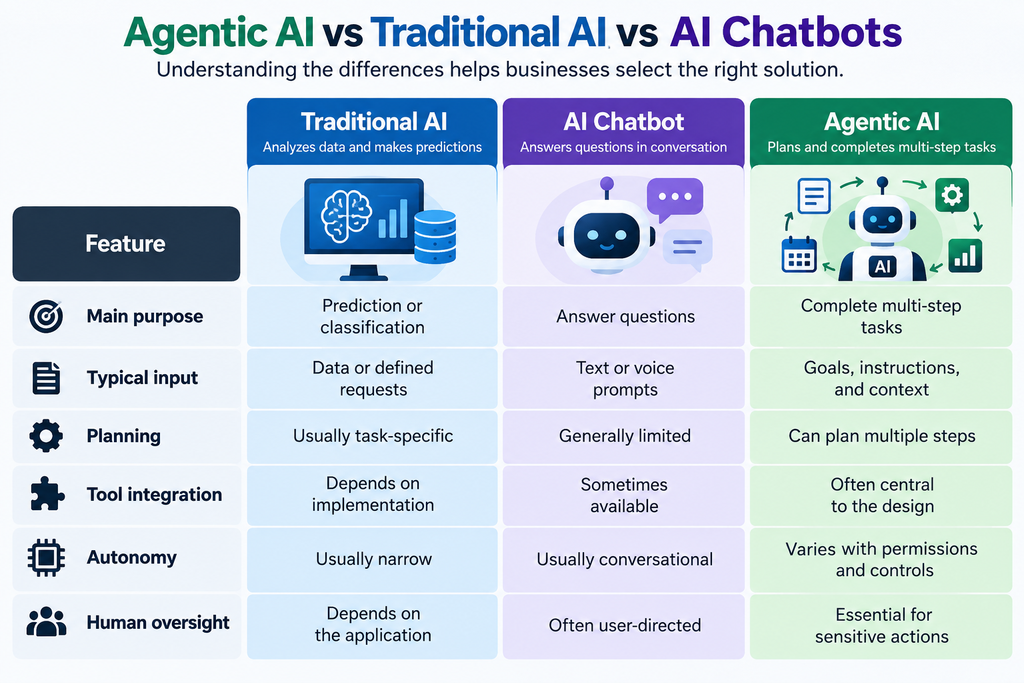
These categories can overlap. A chatbot can include agentic capabilities, and a traditional AI application can be part of a larger agentic workflow.
7 Practical Applications of Agentic AI in Business
Agentic AI can support a variety of business functions. Its effectiveness depends on the quality of the data, integration with existing systems, and how well the workflow is designed.
1. Customer Support Automation
AI agents can help manage customer support workflows by retrieving information, categorizing requests, checking order status, and preparing responses.
For example, an e-commerce support agent could:
- Identify the customer’s question.
- Retrieve relevant order information.
- Check the applicable return policy.
- Prepare a suitable response.
- Route unusual or sensitive cases to a human representative.
This can reduce repetitive work while allowing employees to focus on complex customer problems.
2. Sales and Lead Management
Sales teams often spend considerable time collecting lead information, updating CRM records, and preparing follow-up messages.
An AI agent can help qualify incoming leads using predefined criteria, summarize previous interactions, recommend next steps, and draft personalized follow-ups.
Actions such as sending messages, changing deal stages, or making commitments should follow approved business rules.
3. Marketing and Content Operations
Marketing teams can use AI agents to assist with research, content planning, campaign analysis, and reporting.
Possible applications include:
- Researching a topic using approved sources.
- Preparing a blog outline.
- Drafting social media content.
- Organizing a content calendar.
- Summarizing campaign performance.
- Identifying content that needs human review.
AI-generated content still requires fact-checking, editorial review, and originality checks. Automation should support a strong content strategy rather than replace it.
4. Software Development
AI agents can assist developers with repetitive engineering tasks and structured development workflows.
Depending on the tools and permissions available, an agent may help with:
- Reviewing code and identifying potential defects.
- Generating unit tests.
- Explaining unfamiliar code.
- Investigating build errors.
- Preparing pull requests.
- Updating technical documentation.
Code should be reviewed, tested, and checked for security vulnerabilities before deployment. Access to production systems should be restricted.
5. Finance and Administrative Operations
Businesses can use AI agents to support invoice processing, expense categorization, report preparation, and document verification.
For example, an invoice workflow might extract invoice details, compare them with purchase orders, identify discrepancies, and prepare an item for approval.
Financial transactions, payments, and changes to banking information require strong authorization controls and appropriate human approval.
6. Human Resources and Payroll
AI agents can assist HR teams with administrative workflows such as organizing employee documents, answering policy questions, preparing onboarding checklists, and summarizing attendance information.
In payroll applications, an agent might flag unusual entries or identify missing attendance records before payroll processing.
Sensitive employee information must be protected. Salary changes, payroll approvals, and other high-impact decisions should remain subject to appropriate access controls and review.
7. Cybersecurity Operations
AI agents can help security teams investigate alerts, collect relevant evidence, summarize incidents, and recommend response actions.
Google Cloud documents agentic security workflows that coordinate information across security monitoring and investigation systems. These workflows can include human approval before certain actions are taken.
Security agents should be carefully tested because incorrect actions or manipulated inputs can expose systems to additional risks.
Key Benefits of Agentic AI
When implemented for suitable workflows, Agentic AI can provide several potential advantages.
Reduced Manual Work
AI agents can handle repetitive, rule-based steps and help employees spend more time on tasks requiring judgment and communication.
Faster Workflow Execution
Connecting multiple tools through a coordinated workflow can reduce delays caused by switching between applications.
Improved Operational Consistency
Agents can follow defined procedures and apply the same validation steps across similar tasks, provided the workflow is configured correctly.
Better Access to Business Information
An agent connected to authorized data sources can retrieve relevant information and present it in a useful format.
Greater Scalability
Automated workflows may handle growing volumes of routine requests without requiring every step to be completed manually.
Support for Better Decision-Making
Agents can summarize information, identify patterns, and prepare recommendations. Business leaders remain responsible for evaluating those recommendations and making important decisions.
These benefits are not guaranteed. Businesses should measure actual outcomes against a baseline rather than assume that adding AI automatically improves performance.
Challenges and Risks of Agentic AI
Agentic AI can introduce new risks because it may interact with business applications and take actions beyond generating text.
1. Data Privacy
An agent may access confidential information through connected systems. Businesses should limit access to the information needed for each task and follow applicable privacy requirements.
2. Incorrect Actions
An AI agent can misunderstand instructions, select an unsuitable tool, or produce an incorrect result. Validation, testing, and approval controls help reduce these risks.
3. Prompt Injection and Agent Hijacking
Malicious instructions hidden in emails, documents, or websites can attempt to manipulate an agent into performing unauthorized actions.
The US National Institute of Standards and Technology has highlighted agent hijacking and the need for stronger evaluation methods in its technical guidance on AI agent security.
4. Excessive Permissions
Giving an agent unrestricted access to files, databases, or external services can increase the impact of an error or attack.
Use the principle of least privilege: give each agent only the access it needs.
5. Cost and Reliability
Complex workflows may require multiple model calls, API requests, and verification steps. Businesses should monitor costs, execution time, failure rates, and the need for human intervention.
6. Accountability
Organizations need clear ownership for AI-generated decisions and actions. Logging, monitoring, and escalation procedures help teams understand what happened and who is responsible.
Best Practices for Implementing Agentic AI in 2026
Businesses should start with a clearly defined problem rather than introducing autonomous agents simply because the technology is available.
Step 1: Identify a Suitable Workflow
Choose a repetitive process with measurable outcomes, such as preparing reports, classifying support tickets, or checking invoice information.
Step 2: Define Success Metrics
Determine how success will be measured. Useful metrics include task completion rate, processing time, error rate, cost per task, and employee time saved.
Step 3: Connect the Required Tools
Use controlled API integrations to connect the agent to approved applications and data sources.
Step 4: Establish Permissions
Define which data the agent can read, which actions it can perform, and which actions require approval.
Step 5: Test in a Controlled Environment
Evaluate normal tasks, unusual inputs, incomplete information, malicious instructions, and failure scenarios before wider deployment.
Step 6: Add Monitoring and Human Review
Record important actions, monitor results, and provide a clear way for employees to review or stop an agent’s activity.
Step 7: Improve Gradually
Start with a limited pilot. Expand the workflow only after the system demonstrates acceptable accuracy, reliability, security, and cost.
What Is the Future of Agentic AI?
The direction of Agentic AI is moving toward systems that can work across applications, coordinate multiple tasks, and collaborate with human employees.
Recent industry developments show growing emphasis on connecting agents to enterprise applications, managing their permissions, and controlling their costs. Google’s October 2026 announcement is one example of this trend.
However, more autonomy does not automatically mean better results. Reliable systems will need clear goals, trusted data, secure integrations, measurable performance, and appropriate human oversight.
Businesses that prepare their data, APIs, security controls, and internal processes can be better positioned to evaluate where agentic workflows provide genuine value.
How Technobuzz Systems Can Help Businesses Explore AI Automation
At Technobuzz Systems, businesses can explore software development and technology solutions that support more efficient digital operations.
Depending on project requirements, AI-enabled solutions may include:
- Business workflow automation.
- Custom web application development.
- API integration between business systems.
- AI-assisted customer support workflows.
- Reporting and data-processing automation.
- Security-focused software design.
Every implementation should begin with a clear business requirement, a realistic assessment of feasibility, and suitable privacy and security controls.
If your organization is exploring AI automation, identify one repetitive process, measure its current performance, and evaluate whether an AI-assisted workflow can improve it safely and cost-effectively.
Frequently Asked Questions (FAQs)
1. What is Agentic AI in simple terms?
Agentic AI refers to AI systems that can plan and perform multiple steps toward a goal using available tools, data, and permissions.
2. How is Agentic AI different from generative AI?
Generative AI focuses on producing content such as text, images, and code. Agentic AI uses AI capabilities within a workflow that may include planning, tool use, and taking actions. An agent can use a generative AI model as one of its components.
3. Can small businesses use Agentic AI?
Yes. Small businesses can explore focused applications such as customer inquiry classification, report preparation, lead management, and document processing. The best starting point is a low-risk workflow with measurable benefits.
4. Is Agentic AI safe for business use?
It can be used responsibly when supported by appropriate security measures, restricted permissions, testing, monitoring, and human approval for sensitive actions. No implementation is completely risk-free.
5. Does Agentic AI replace employees?
Agentic AI can automate some tasks and change how employees work. In many cases, its practical role is to support employees by reducing repetitive work, while people retain responsibility for judgment, relationships, and high-impact decisions.
6. What technologies are used to build AI agents?
AI agents may use large language models, APIs, workflow orchestration, databases, retrieval systems, authentication mechanisms, and monitoring tools. The appropriate architecture depends on the business problem and its security requirements.
7. How can a company get started with Agentic AI?
Start by identifying a suitable workflow, defining success metrics, selecting the necessary integrations, setting permissions, and testing a small pilot before expanding.
Conclusion
Agentic AI is an important development in business automation because it enables AI systems to move beyond answering questions and assist with completing connected tasks.
Its value comes from solving real operational problems—not simply adding AI to an existing process. Businesses should focus on practical use cases, reliable integrations, measurable outcomes, and security from the beginning.
With the right approach, Agentic AI can become a useful part of a company’s digital transformation strategy in 2026 and beyond.
Leave a Reply