Introduction
Search in 2026 looks very different from just a few years ago. Today, users often ask full questions (voice or text) and rely on AI tools to get instant answers instead of clicking through search results. As Salesforce notes, “marketing was built around a customer path that no longer exists. Today customers discover and decide in AI answers, often before they reach your site”. In this new environment, ranking #1 on Google is no longer enough. If your brand doesn’t show up in AI-generated answers (like ChatGPT responses or Google’s AI Overviews), you could be missing out on significant visibility and traffic.
Answer Engine Optimization helps businesses structure their website content so that AI-powered search experiences can more easily understand and use relevant information.
Traditional SEO focuses on ranking pages in search results, but Answer Engine Optimization (AEO) focuses on becoming the answer itself. This guide will explain what AEO is, why it matters, and how to optimize your content to get cited by AI assistants. You’ll learn how AEO differs from SEO, why it’s critical in 2026, and the key strategies and tools to improve your visibility in AI-powered search. By the end, you’ll have actionable tips to make your content stand out in featured snippets, voice answers, ChatGPT, and other AI-driven platforms.
What Is Answer Engine Optimization (AEO)?
Answer Engine Optimization (AEO) is the practice of structuring content so that AI-powered answer engines (such as ChatGPT, Google’s AI Overviews, voice assistants, and other AI search tools) extract, synthesize, and cite your content as the direct answer to user queries. In other words, instead of trying to rank a page among many links, AEO aims to make your content the single recommended answer when someone asks a question.
More simply, AEO means organizing and writing content in a way that answer engines can easily use it. For example, defining terms in one concise sentence, using clear question-and-answer headings, and adding appropriate schema markup helps AI systems parse and present your content. As one AI search specialist explains, an answer engine “reads candidate sources, synthesizes a response, and decides which sources to credit by name”. AEO is about becoming one of those credited sources.
Key examples of answer engines include:
- Google AI Overviews (Gemini) – Google’s generative search feature that provides AI summaries on top of search results.
- OpenAI’s ChatGPT (including ChatGPT Search) – Conversational AI that can answer questions and cite web sources.
- Microsoft Copilot (Bing AI) – Bing’s chat-based answer engine that uses AI to provide answers and cite sources.
- Perplexity AI – A generative search tool that sources its answers from recent web content.
- Voice Assistants (e.g. Alexa, Siri) – These devices often pull direct answers from featured snippets or knowledge panels.
- Other LLM-based tools – New platforms (like Anthropic’s Claude or xAI’s Grok) that answer user queries using large language models and cite their information.
AEO matters because users increasingly rely on these AI answers. In late 2025, ChatGPT reached 900 million weekly users worldwide, and Perplexity saw about 780 million queries in May 2025. Google’s AI Overviews show up in roughly 25% of searches (Conductor data, autumn 2025). In practical terms, companies have seen AI-referred sessions grow nearly tenfold in less than a year. Being featured as the AI-provided answer means getting in front of users earlier (often at the research stage) and building your brand as a trusted source.
How Does AEO Work?
AEO works by aligning your content with how AI answer engines find and use information. Here’s a simplified step-by-step process:
- User asks a question. An online user poses a query, either by typing or speaking a question into an AI tool (e.g. “What is answer engine optimization?”).
- Answer engine interprets the query. The AI system uses natural language understanding to figure out what the user wants. Unlike traditional search engines that look for matching keywords, answer engines parse the full intent of the question.
- Engine retrieves and evaluates content. The AI searches for relevant information across the web or its own knowledge base. It “reads” candidate sources — pages that contain answers — and evaluates which passages are most relevant. For example, ChatGPT and Perplexity will scan content from websites and databases for concise answer snippets.
- Engine generates a response. The system synthesizes an answer by combining information from those sources. This answer is typically a single, clear response rather than a list of links.
- Engine cites sources. Finally, the AI decides which sources to credit. It may cite one or more URLs (or simply mention a brand by name) that it used to form the answer. For instance, ChatGPT often cites authoritative directories first (like Wikipedia) and then web pages with clear facts.
It’s important to note that each AI platform has its own behavior and signals:
- ChatGPT (OpenAI): Tends to favor sources with strong brand presence and directory listings. Brand mentions (even unlinked) and consistency across the web are key factors.
- Perplexity AI: Strongly emphasizes recency and explicit references. It prefers pages with recent
dateModifiedvalues and visible source links for facts. - Claude (Anthropic): Looks for longer, well-sourced content with declared authorship and original data.
- Gemini (Google): Leverages Google’s ecosystem – a complete Google Business Profile, Knowledge Graph entity links, and schema data all help.
- Grok (xAI): Trained on social data (formerly Twitter/X), it heavily weighs brand mentions on social media for citation.
- Voice Assistants: Often rely on whatever Google or Bing will return as a featured snippet or knowledge panel.
Because of these differences, inclusion in AI answers isn’t guaranteed just by publishing content. However, you can optimize your content and site (following AEO best practices below) to improve your chances of being cited across different AI search engines.
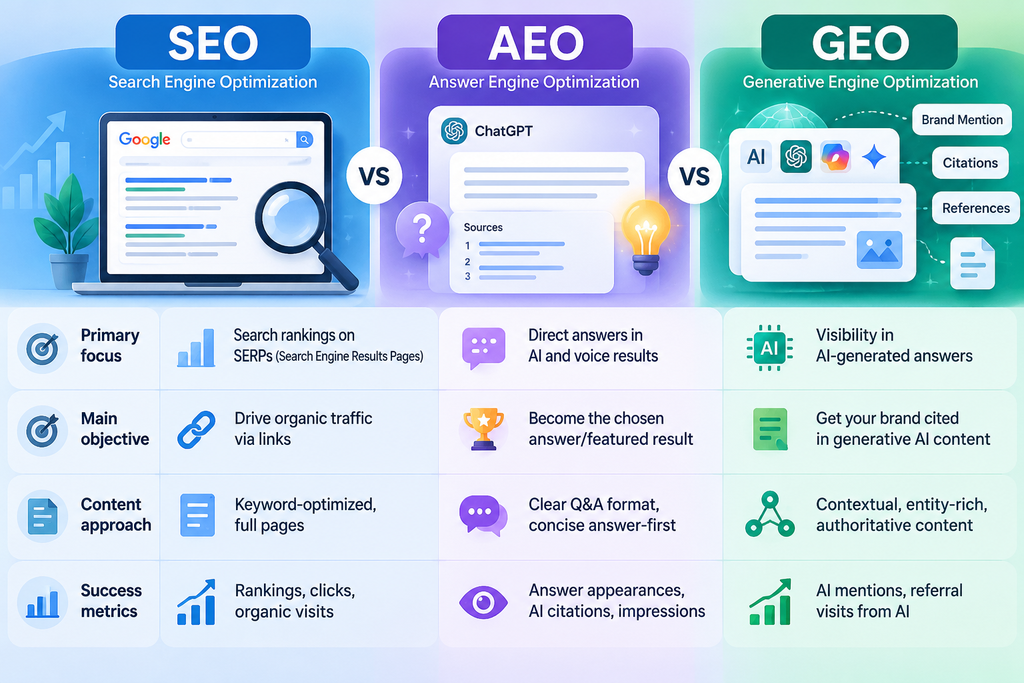
- SEO (Search Engine Optimization): Focuses on ranking well in traditional search engines (Google, Bing, etc.) by optimizing keywords, links, and on-page elements. Success is measured by page rank and organic traffic.
- AEO (Answer Engine Optimization): Focuses on structuring content for direct answers and AI assistants. The goal is for your content to be extracted as the single answer or featured snippet. Metrics include how often AI tools cite your content or brand.
- GEO (Generative Engine Optimization): Essentially synonymous with AEO in practice. Both terms refer to optimizing content for AI-powered answer systems. The slight difference often noted is that “GEO” emphasizes the generative process (the AI composing answers), while “AEO” emphasizes delivering the answer. In industry usage, they overlap heavily.
- Answer Engine Optimization complements traditional SEO by focusing on content that directly addresses users’ questions, while GEO focuses on visibility within generative AI responses.
All three approaches can complement each other. Good SEO (crawlability, relevance, authority) lays the foundation that helps answer engines find your content. Similarly, the authority signals (backlinks, brand reputation) that boost SEO also make your content more credible to AI systems. In practice, focus on providing high-quality, authoritative content: it will help both your search rankings and your chance of being cited in AI answers.
Why Is AEO Important in 2026?
AI-powered search is rapidly growing, and user behavior is shifting toward conversational, zero-click queries. Several trends make AEO vital:
- Explosive growth of AI search tools: By early 2026, ChatGPT had roughly 900 million weekly users, and billions of prompts per day. Google’s AI Overviews are now default on mobile search for English queries and appear in about 1 in 4 searches. These platforms collectively handle billions of question-answer interactions monthly.
- Changing query style: Unlike traditional search (short keywords), users now ask full questions. In fact, a Semrush study found 65–85% of ChatGPT prompts didn’t match any keywords in traditional search tools, because people phrase conversational questions (e.g. “How to optimize site for ChatGPT answers?”) rather than fragmented keywords.
- Zero-click trends: Even before generative AI, over half of Google searches ended without a click (SparkToro 2024). AI answers take this further by resolving queries on the spot. As one expert notes, on a direct-answer result there is no second or third place – your content either wins or loses visibility.
- Early-funnel opportunities: Getting cited in AI answers can put your brand in front of potential customers at an earlier research or consideration stage. This builds trust and can eventually drive interest down-funnel. Ahrefs points out that even “zero-click” answers can build brand recognition: being the cited answer still exposes users to your brand.
- Competitive advantage: Traditional SEO and paid ads are becoming more crowded and costly. A strong presence in AI answers offers new visibility channels. As one analyst summarizes, if your brand isn’t appearing in AI-generated responses, “you’re missing a major share of modern search visibility”.
- Answer Engine Optimization helps businesses make their content easier to discover in AI-powered search experiences by providing clear, useful, and trustworthy answers.
In summary, AEO is important because search is shifting from links to answers. By 2026, users expect instant, conversational answers. Brands that adapt with AEO can maintain visibility and authority even when users stop clicking through search results.
Top AEO Strategies to Improve AI Search Visibility
To improve your chances of being cited by AI answer engines, focus on creating content that these systems prefer. Here are top strategies:
A successful Answer Engine Optimization strategy combines clear answers, helpful headings, authoritative sources, technical SEO, and a positive user experience.
- Create Question-Based ContentIdentify the real questions your audience asks. Use tools like Google’s People Also Ask or analyze forum discussions to discover these queries. Then write your content to directly address them. For example, use headings like “What is Answer Engine Optimization?” or “How does AI search work?” to mirror actual user questions. This helps AI algorithms match your content to those queries.
- An effective Answer Engine Optimization strategy combines question-based content, clear headings, authoritative sources, technical SEO, and a helpful user experience.
- Answer Questions DirectlyFor each question-oriented heading, provide a concise answer immediately underneath. Answer engine algorithms often extract short, self-contained snippets. For example, open with a 30–40 word definition or key fact. CDP.com advises that a page should “open with a 30–40 word definitional sentence… which the engine can return verbatim”. After the direct answer, you can expand with more context, but the essential information should come first. Avoid burying the answer deep in paragraphs.
- Use Structured Content and FormatsOrganize your content clearly. Use descriptive H2/H3 headings (reflecting questions), bullet points, numbered lists, and tables where appropriate. These formats make it easier for AI systems to identify and extract key information. For example, Google’s advice for featured snippets is to match the format (a short paragraph, a list, or a table) to the query type. As CDP.com explains, “featured snippets and voice answers favor specific shapes: a concise paragraph for definitions, a numbered list for processes, and a table for comparisons”. By structuring content this way, you increase the odds that an AI will lift your answer.
- Strengthen Expertise, Authority, and Trust (E-E-A-T)Demonstrate credibility to both search engines and AI assistants. Include author bylines or references that show expertise. Back up claims with data and cite reputable sources (with visible dates). As Ahrefs notes, answer engines require content to be “clear, structured, and trustworthy”. Provide context (e.g. author profiles, up-to-date research) that signals your content is authoritative. Also, showcase any real-world experience: case studies, research findings, or first-party data can signal expertise to AI systems. Remember, AI assistants are more likely to cite sources they deem authoritative (e.g. Wikipedia entries or known publications).
- Implement Relevant Structured DataUse Schema.org markup to label your content type. For instance, add an Article or BlogPosting schema on blog posts, FAQPage schema for FAQ sections, and Organization schema for your homepage (with business name and logo). Also consider BreadcrumbList and LocalBusiness (if applicable). These schemas help AI systems parse your content and differentiate your brand from others. However, be aware that recent studies show simply adding schema does not guarantee AI citations. The real value of schema is ensuring your content is correctly understood (e.g. by Google) and enabling classic rich results. So use schema as a best practice, but focus on substance as well. (And always make sure your schema matches the visible content exactly to maintain trust.)
- Improve Technical AccessibilityMake it easy for crawlers and AI agents to find your content. Ensure important pages are indexable: avoid hiding answers behind login walls or extensive scripts. CDP warns that “serving the answer only after JavaScript runs” or blocking bots can prevent AI fetchers from seeing it. Use clear URLs, mobile-friendly design, fast page speed, and canonical tags where needed. In short, apply standard technical SEO best practices: AI assistants rely on crawlers to fetch web content, so good crawlability and performance are foundational.
- Build Your Brand’s Web PresenceAI systems often prefer citing well-known brands. Increase your brand mentions on the open web – in industry articles, directories, and other sites – even if not all have links. According to research, brand mentions (linked or unlinked) correlate strongly with AI visibility. For example, an Ahrefs study found a much higher correlation between brand mentions and being cited by ChatGPT than between domain rating and citations. So publish original research, get featured in reputable media, keep business info (name, address, profiles) consistent, and consider content partnerships that increase mentions. Also be thorough about entity signals: maintain an accurate Google Business Profile, Wikipedia/Wikidata entry, and social profiles. These reinforce your brand’s credibility to AI platforms.
- Keep Content Fresh and AccurateRegularly review and update your content. AI models value recency and factual accuracy. Perplexity in particular “weights recency and entity confidence heavily”. That means having a recent update date on your content (e.g. a visible “last updated” timestamp) and citing the latest data can improve chances of being cited. Fix outdated stats, refresh examples, and add new information as it becomes available. AI assistants will more likely trust a page that looks up-to-date and maintains correct, current information.
- By combining these strategies – direct question/answer content, clear structure, credibility signals, and solid technical setup – you give AI answer engines the best possible content to extract from. This doesn’t replace traditional SEO, but it aligns your pages with how AI systems consume and cite web content.How to Optimize Your Website for ChatGPT and Google AI Overviews
- To perform well on platforms like ChatGPT and Google AI Overviews, follow these practices site-wide:
- Publish clear, helpful content: Write for humans and AI. Make sure the same content is readable by both a person and an automated system. Avoid hidden or overly concise answers that only a crawler could find. Instead, clearly explain your key points in natural language (which benefits SEO and AI alike).
- Ensure crawlability: Important content should be accessible without special scripting. For example, avoid loading answer content only via client-side scripts. Use HTML that can be indexed, and check robots.txt to ensure you haven’t accidentally blocked any AI user-agents.
- Use plain language and definitions: Write answers in a straightforward, declarative style. If you mention technical terms, consider defining them in place or linking to definitions. This helps AI models extract self-contained answers.
- Support claims with sources: Since ChatGPT and Google’s AI often cite trustworthy sources, always back up factual claims with references. For example, mention study results with a citation, or link to authoritative statistics. This makes your content more likely to be picked as a credible source.
- Organize site information: Clearly present your business info (services, location, expertise). For example, include an “About” section and consistent branding. Google’s AI (Gemini) leans on Knowledge Graph data, so a well-maintained Google Business Profile and accurate schema for your organization help.
- Monitor AI referrals: Use analytics creatively. While direct measurement of ChatGPT traffic is hard, you can track branded search volume changes, referral patterns, or look for spikes in organic impressions after publishing an answer-friendly article. Additionally, tools like Ahrefs’ Brand Radar can show which AI platforms mention your brand.
- Understand platform differences: Keep in mind that no single solution fits all. ChatGPT, Google AI Overviews, Bing Copilot, etc., have different AI models and rules. You won’t get guaranteed citations, but optimizing broadly (as above) positions you well on all channels. For example, if you’re a local business, focus on Google’s ecosystem (GBP, local schema) for Gemini, while also posting FAQ-style content that ChatGPT would find useful.
- By treating your website as the raw material for AI answers – with structured, factual content that’s easy to parse – you maximize your presence across AI search tools. In practice, AEO is about integrating these best practices into your existing SEO/content strategy and checking for AI success over time.
- Best AEO Tools in 2026
- While there’s no tool that “automagically” makes you appear in AI answers, the right tools can help you audit and improve AEO performance:
- Search Performance Tools (Google/Bing):
- Google Search Console – Check your indexing and Google search performance. It also has a Generative AI section that shows how often your pages appear in Google AI Overviews (if that feature is enabled).
- Bing Webmaster Tools – Includes an AI Performance report listing queries where Bing Chat (Copilot) cited your site. Useful for understanding Bing AI visibility.
- Web Analytics (Google Analytics, etc.): Track overall traffic trends. When doing AEO, watch for shifts like page impressions remaining stable while clicks drop – that could indicate your answer being extracted (as CDP.com suggests). Also monitor branded search volume as an indirect signal of awareness.
- Structured Data Validators:
- Google Rich Results Test – Verify your structured data (FAQPage, Article, etc.) is valid and eligible for rich results.
- Schema Markup Validator (schema.org) – Check that your JSON-LD or Microdata is syntactically correct. Keeping schema accurate ensures AI systems see the right signals (though it’s not a magic bullet).
- AI Visibility Monitoring:
- Ahrefs’ Brand Radar – A tool designed to track what various AI chatbots say about your brand. It can run your brand queries through ChatGPT, Bard, etc., and show the answers and sources. This is useful for seeing whether your content is being cited (and for spotting misinformation about your brand to correct).
- Other monitoring tools (like mention trackers or social listening) – While not specifically for AI, tracking brand mentions can indicate how often your brand is discussed online, which correlates with AEO performance.
- Keyword and Question Research: Use SEO tools (e.g. Ahrefs, SEMrush) to find commonly asked questions and conversational queries in your niche. This informs your AEO content strategy (the right questions to answer).
- Content Experience Platforms: Some marketing platforms now include “AI search optimization” features, but remember, no tool replaces writing valuable content. Use them for ideas, but prioritize strategy over any tool’s suggestion.
- The key is to use these tools to measure and iterate – check which queries you appear for (in AI or search), refine your content, and monitor traffic/referral changes over time.
- Common AEO Mistakes to Avoid
- Even well-intentioned content can fail in AI search if optimized incorrectly. Common pitfalls include:
- Focusing on keywords, not answers: Simply stuffing questions or keywords (e.g. headlines like “AEO Overview” instead of a real question) doesn’t help. CDP.com warns against “optimizing the format before answering the question”. For instance, inserting a question mark to hit SEO goals but not actually answering the question in the text will lose to a simpler, straightforward response.
- Over-hedging the answer: Starting a definition with qualifiers like “It depends…” or “There is no single definition” sounds informative but gives AI nothing to extract. Always lead with the direct answer (e.g. “Answer Engine Optimization is X”) and put nuances after.
- Misaligned schema: Don’t use schema markup that doesn’t match the on-page content. For example, having FAQPage markup for questions you never answered on the page confuses AI agents. CDP notes that mismatched structured data can hurt credibility.
- Inconsistent content: If you define a term differently on multiple pages, AI might pick up a mix or avoid citing you. Keep canonical answers – CDP suggests having one “owner” page per definition and reusing that phrasing.
- Relying solely on AI-generated text: Publishing generic AI-written content without review is risky. AI assistants prefer verifiable facts and may ignore or contradict content that lacks sources or originality. Always fact-check and personalize any AI-assisted writing.
- Hiding the answer: If your page loads the answer via JavaScript or puts it far down the page, an AI crawler might miss it. Make sure the answer content is in the initial HTML.
- Expecting guaranteed citations: AEO is not instant. It takes ongoing effort. There is no guaranteed way to “force” an AI to cite you. Think of it as playing long game – consistent quality and authority signals win out over time.
- By avoiding these mistakes, you ensure your content stands the best chance of being selected as the answer.
- AEO Implementation Checklist
- Use this checklist to audit a page or plan new content for AI answer optimization:
- Identify target audience and intent: Determine who will read this and what specific question they need answered.
- Research relevant questions: Find the exact questions your audience asks (via forums, People Also Ask, keyword tools).
- Write a direct answer up front: Start with a concise answer to the question in 40–80 words.
- Use clear, question-style headings: Structure the page with headings that mirror the questions.
- Add examples and authoritative sources: Support your answer with data, examples, and citations to credible references.
- Apply relevant structured data: Use schema types (FAQPage, Article, etc.) that match your content.
- Ensure crawlability and indexing: Check that the page is indexable, fast, and mobile-friendly.
- Include internal links: Connect to related content on your site (this helps site architecture and authority).
- Review accuracy and freshness: Update outdated information and verify all facts/claims.
- Track AI visibility: Use tools (Search Console, Brand Radar) to monitor if and how your content is being cited in AI answers.
- Frequently Asked Questions (FAQs)
- What is AEO in digital marketing?
Answer Engine Optimization (AEO) is the practice of optimizing website content so that AI-powered answer engines (like ChatGPT, Google AI Overviews, or voice assistants) provide your content as a direct answer. It involves writing clear question-answer formatted content, using relevant schema, and building trust signals so that AI systems extract and cite your brand as a source. - What is the difference between AEO and SEO?
SEO (Search Engine Optimization) focuses on ranking pages in search engines, measured by position and clicks. AEO focuses on being the returned answer in AI search, where a click might not even occur. As CDP.com explains, “SEO optimizes for ranking… AEO optimizes for being the returned answer”. They are complementary: SEO ensures visibility in search results, while AEO targets answer surfaces. For example, SEO might aim for a top-3 result, whereas AEO aims to have your content appear in a chatbot reply or featured snippet. - How does Answer Engine Optimization work?
AEO works by structuring content so AI systems can easily use it. When a user asks a question, an AI engine reads relevant web content, generates an answer, and credits sources. To optimize, you write pages that directly answer common questions, using clear formats (like short paragraphs, lists, tables) that the AI can extract. The AI “synthesizes a response and decides which sources to credit by name”, so AEO involves shaping your content to fit what AI algorithms prefer (clear answers, citations, strong brand signals). - How can I optimize my website for AI search?
Publish high-quality, accessible content that provides clear answers. Use question-based headings and lead with concise definitions or answers. Include FAQ sections if relevant, and add schema markup (FAQPage, Article, etc.). Ensure your pages load fast and can be crawled. Also build your brand’s online presence (consistent business info, Wikipedia or Google Knowledge Panel entries). In practice, follow the AEO strategies above (question-led content, structured data, technical SEO) to make your site AI-friendly. - Can AEO help my business appear in ChatGPT answers?
Yes. AEO specifically targets chatbots like ChatGPT. By optimizing your content to be easily extracted and cited, you increase the chance that ChatGPT will mention your brand or webpage when answering relevant queries. For example, if ChatGPT recognizes your content as authoritative, it may include your brand name or link when it provides an answer. However, results vary by industry and query – consistent effort is needed. - Is FAQ schema necessary for AEO?
FAQ schema can help organize question-and-answer pairs for AI, but it’s not strictly “necessary” for AEO. Structured data provides machines with explicit cues, but by itself it won’t guarantee an AI citation. If you have genuine FAQ content, mark it up. Google’s own guidance says to use FAQPage schema for real Q&A text. Just ensure whatever schema you use accurately reflects the visible content. In summary, use FAQ schema if appropriate, but focus first on writing useful Q&A content. - How long does it take to see AEO results?
AEO is typically a medium to long-term effort. Just like SEO, it can take weeks or months to see results. Initially, measure basic signals (like site traffic or whether AI mentions appear in tools). It can take time for AI systems to crawl updated content and for your brand’s signals (mentions, backlinks) to accumulate. There’s no fixed timeline – consistency and ongoing optimization are key. - Is AEO replacing traditional SEO?
No, AEO is not replacing SEO; it’s an extension. While SEO optimizes for search engine rankings, AEO optimizes for answer surfaces. Most experts agree the signals overlap substantially, and that strong SEO foundations (site authority, crawlability) also support AEO. Think of AEO as adding a new channel of visibility. Companies should integrate AEO practices alongside SEO rather than abandoning SEO entirely. - What are the best tools for AEO?
Besides the general SEO tools (Search Console, Analytics), there are some AI-specific tools. Ahrefs Brand Radar is one – it shows how AI chatbots currently describe your brand. Google Search Console’s generative AI report and Bing’s AI tools (as mentioned above) can show which queries cite your site. For content creation, use Q&A research tools (like SEMrush, AnswerThePublic) to find questions. Ultimately, the “best tool” is quality content: use tools to find questions and measure results, but write the answers yourself. - How can I measure AEO performance?
AEO performance isn’t measured by rank or clicks. Instead, track AI answer share and brand visibility. For example, record if your page appears as an answer (or is cited) for target queries in ChatGPT, Bard, etc. (Some teams build prompt-tracking systems.) Use Bing Webmaster’s AI Performance report or Google Search Console’s generative AI data for clues. Also monitor indirect signals: stable or rising branded search volume can indicate brand presence. In short, measure how often AI surfaces your content, rather than traditional metrics. - Conclusion
- In 2026’s search landscape, optimizing for AI-driven answers is no longer optional – it’s essential. Answer Engine Optimization (AEO) ensures your content is found and used by the AI assistants and search features people increasingly rely on. Remember: AEO is about providing real value – clear answers, useful data, and credible information – in a format AI systems can extract. Technical optimizations (schema, site performance) and strong authority signals (brand mentions, expertise) support that goal.
- By integrating Answer Engine Optimization with traditional SEO, businesses can strengthen their search visibility and improve the accessibility of their content across evolving search experiences.
- By integrating AEO best practices with your ongoing SEO strategy, you protect and enhance your online visibility. Whether users search with ChatGPT, Google, or voice commands, you want your brand to be part of the answer. Start applying AEO strategies today – identify the questions your audience asks, craft concise answer-first content, and build your brand’s credibility online. As the AI search era grows, businesses that embrace AEO will be the ones who get noticed first.
Leave a Reply