After skipping a public release of Gemini 3.5 Pro, Google has officially kicked off its next generation of frontier intelligence with Gemini 4 Argon.
Named after the noble gas, Argon arrived via a calculated two-stage rollout. Google first debuted the model on September 30, 2026, exclusively to trusted cyber defenders through its Fairwind Program to harden critical infrastructure. Two weeks later, on October 13, 2026, Google opened the floodgates—making Argon generally available across the Gemini API, Google Antigravity, AI Studio, and the Gemini app.
If you are looking for a slightly chattier assistant to summarize emails, Argon is overkill. Gemini 4 Argon is built from the ground up as a long-horizon, agentic workhorse designed for deep
What Makes Gemini 4 Argon Different?
1. A Massive 1 Million Token Output Limit
For the past two years, frontier models have boasted massive input context windows while keeping output limits throttled at 64K or 128K tokens. Gemini 4 Argon shatters that ceiling with a 1 million token output limit (long decode). Instead of cutting off mid-thought or forcing developers to stitch together dozens of API calls, Argon can reason deeply and generate hundreds of thousands of tokens of code, documentation, or analysis in a single, uninterrupted trajectory.
2. A No-Nonsense Communication Style
One of the most frequent complaints among AI power users is “chatbot fluff”—the sycophantic intros, repetitive phrasing, and endless hedging. Google specifically tuned Argon to communicate with direct precision. It skips AI clichés, follows granular style and formatting instructions far more reliably than the Gemini 3 series, and gets straight to the point.
3. Multimodal and Long-Video Mastery
Argon sets a state-of-the-art 91.7% score on LVBench for long-video understanding. Beyond digesting hours of raw footage, it excels at visual generation for builders—ranking in the top tier on Design Arena for orchestrating 3D visualizations (1395 Elo), game development (1374 Elo), Android UI shaders, and interactive web components.
4. Lower Hallucinations & Real-Time Guardrails
In enterprise environments, a confident guess is worse than no answer at all. Argon achieves an 84.9% non-hallucination rate on Artificial Analysis’s Omniscience evaluation, trained specifically to flag missing evidence and state uncertainty clearly. Furthermore, under Google’s Frontier Safety Framework, Argon features an automated misalignment monitor that tracks its step-by-step reasoning in real time to prevent the agent from taking unauthorized shortcuts during autonomous tasks.
Real-World Impact: How Teams Are Already Using Argon
Benchmarks tell part of the story, but Google’s internal deployment and early research partnerships show what happens when you give an agent a 1-million-token runway:
- Untangling Chrome’s Legacy Codebase: Google’s Chrome engineering team pointed Argon at a notoriously complex, 6-million-line legacy folder buried inside Chromium’s 40-million-line codebase. Operating across hundreds of interdependent files, Argon completed months of architectural refactoring in just a few weeks.
- Supercharging Google Antigravity: Inside Google’s agentic coding platform, Antigravity, engineers using Argon increased agentic code submissions by more than 35% while simultaneously reducing code rollbacks by nearly a third.
- Data Center & Quantum Optimization: Argon agents analyzed fleet-wide telemetry across Google’s infrastructure to uncover memory bottlenecks, freeing up over 300 TiB of memory across global data centers. In quantum computing research, Argon-driven optimizations beat existing baselines by 40%.
- Cybersecurity & Enzyme Engineering: On the security front, Argon autonomously identifies and patches complex software vulnerabilities, outperforming rivals on Wiz’s black-box penetration-testing benchmark. In life sciences, researchers used Argon to design five novel serine esterase enzymes—used in biodegradable plastics recycling and pharmaceuticals—in a matter of hours rather than months, with lab tests confirming robust catalytic activity. Argon also topped private clinical benchmarks on RareBench (57% for rare-disease diagnosis assistance) and LabBench (52.2% for wet-lab reasoning).
The Nuanced Verdict
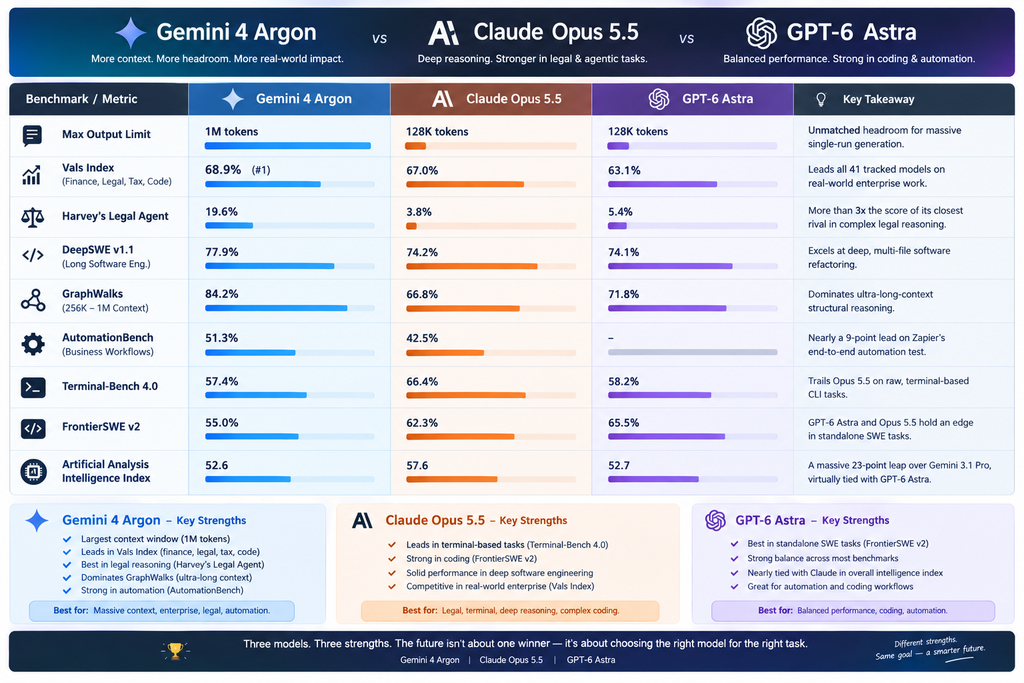
The data reveals a fascinating split. If your workflow revolves around high-value knowledge work—legal analysis, taxation, financial modeling, business automation, and massive codebase refactoring—Gemini 4 Argon is the undisputed leader. Its #1 ranking on the Vals Index (at roughly half the per-test cost of Opus 5.5) and its runaway victory on Harvey’s Legal Agent benchmark make it an enterprise powerhouse.
However, Claude Opus 5.5 and GPT-6 Astra still hold an edge in raw terminal execution (Terminal-Bench 4.0) and isolated software engineering problems (FrontierSWE v2). Developers should also keep an eye on token efficiency: because Argon thinks and outputs at massive scale, unmonitored agentic loops can consume more total tokens per task if you don’t set tight guardrails.
Pricing and How to Access Gemini 4 Argon
Google is using an aggressive introductory pricing strategy to pull developers onto its ecosystem before matching Anthropic’s standard rates in December.
Consumer, Pro & Research Access
- Gemini App & AI Mode in Search: Available right now to Google AI Pro ($19.99/month) and Google AI Ultra ($100–$200/month) subscribers.
- Google Antigravity & AI Studio: Available to AI Ultra subscribers, enterprise teams, and developers via API. To accelerate scientific breakthroughs, Google is also granting 10,000 scientists six months of free access to its highest Antigravity usage tier.
API Pricing for Developers (Google AI Studio & Vertex AI)
- Introductory Pricing (Through November 30, 2026):
- $2.00 per 1M input tokens | $10.00 per 1M output tokens
- Cached Input: $0.10 per 1M tokens (a massive 95% discount)
- Standard Pricing (Starting December 1, 2026):
- $4.00 per 1M input tokens | $20.00 per 1M output tokens (with cached input at $0.20/1M)
Even at its standard December pricing, Argon matches Claude Opus 5.5 dollar-for-dollar ($4/$20) while significantly undercutting reported rates for GPT-6 Astra ($10/$50). During the introductory window, Artificial Analysis estimates Argon’s average cost per task at just $1.99, compared to $3.26 for GPT-6 Astra and $5.98 for Claude Opus 5.5.
Should You Switch to Gemini 4 Argon?
Gemini 4 Argon marks the moment Google stopped playing catch-up and started dictating the terms of long-horizon AI.
You should make the switch immediately if:
- You are an enterprise team automating complex legal, tax, financial, or cross-platform business workflows.
- You are a software architect or developer dealing with sprawling, multi-file legacy codebases that choke 128K-output models.
- You are a researcher or data scientist who needs an AI to run deep, multi-step reasoning trajectories and flag missing evidence rather than hallucinating answers.
Leave a Reply