
Tesla Roadster 2026 is attracting attention for its futuristic electric sports-car design, SpaceX-inspired technology, and Tesla’s advances in AI-powered driving systems. In this article, we explore its expected features, performance claims, AI technology, and potential impact on the future of electric vehicles. Tesla’s newly unveiled Roadster (Oct 15, 2026) is a radical electric sports car featuring SpaceX-derived thrusters and ground-breaking aerodynamics. It’s offered in three trims – Performance (road-ready with suction fans), Thrust (race-ready with rear-mounted cold-gas thrusters), and Rocket (air-ready with ten thrusters). All trims share a 300-mile range and 230+ mph top speed. A demo run achieved a blistering 0.81 seconds 0–60 mph (with Tesla claiming even faster production performance). Production is targeted for 2028. We contrast the Roadster’s specs with rival electric hypercars (Rimac Nevera, Lotus Evija, Battista) in a comparison table.
Meanwhile, Tesla’s AI systems underlie its Autopilot/Full Self-Driving (FSD) features. Tesla uses a vision-only neural network approach: 8 cameras feed 48 deep-learning networks trained on petabytes of fleet data. FSD v12 (late 2023) replaced 300,000+ lines of rule-based code with an end-to-end “neural net” that takes raw pixels and outputs steering/braking. We detail Tesla’s AI hardware (Dojo supercomputer, custom HW4 chips) and safety/regulatory context.
Key points: The Roadster is a halo car (safety is secondary). Tesla’s FSD is still assistance – drivers must watch the road. We clearly differentiate demo-only features (flight stunts in Rocket trim) from production capabilities. The FAQ addresses likely reader questions about Roadster specs, release timing, and AI driving. Lastly, a mermaid timeline traces the Roadster announcement (Oct 2026) through planned production (2028) and key Tesla AI developments (FSD v14, EU rollout).
The 2026 Tesla Roadster: Key Specs and Features
In October 2026, Tesla finally revealed the long-delayed second-generation Roadster. Its standout feature is a cold-gas thruster system co-developed with SpaceX. The Roadster carries a high-pressure composite overwrapped pressure vessel (COPV) filled with compressed nitrogen (~600 L total in Flight mode) feeding multiple nozzle thrusters. Four forward nozzles (near the rear wheels) provide thrust for acceleration and jumps; additional lateral and nose-mounted thrusters allow flips and short hops (the Rocket trim has four downward and two sideways thrusters). Each thrust nozzle sprays high-pressure gas (up to ~10,000 psi) to add force beyond what tires alone can deliver. Tesla’s vehicle engineering lead, Lars Moravy, explained that the Roadster’s 10 thrusters (fed by a 600 L COPV) let it “lift and spin the car in midair”. Tesla also built a vacuum-suction fan system under the car that can dramatically increase downforce, theoretically enabling the car to hold to a ceiling if needed (as a marketing stunt).
All Roadster variants use a 100+ kWh battery (Tesla’s next-gen 4680 cells with new chemistry) and dual 340+ kW motors (one front, one rear, derived from Plaid tech). Tesla claims ~300 miles of range for every trim. In performance, the Roadster is head-turning: at the reveal event it accelerated 0–60 mph in 0.81 seconds (with SpaceX thrusters active). Tesla’s goal is even faster production speeds (they claim ~0.59s in the one-seat Rocket trim). Top speed is targeted above 230 mph (370 km/h) for the elite Rocket model. For context, Tesla expects >1,000 hp output – exceeding its Model S Plaid’s power.
The Roadster’s design is markedly angular, inspired by jets like the SR-71 and F-35, and departs from Tesla’s earlier curvy S3XY styling. It has hidden headlights, flush aerodynamics, and a single central touchscreen with a yoke (no conventional steering wheel). Materials like magnesium, titanium and carbon-fiber are used to cut weight. Importantly, safety is not the prime goal of this hypercar: Elon Musk openly joked that if “safety is your number-one goal, do not buy the Roadster”. He acknowledged it’s a halo or “concept” car: it won’t move Tesla’s volume sales but showcases cutting-edge technology.

Trim Levels and Availability
Tesla is offering three Roadster trims:
- Performance (road-ready): Two seats, active aero and the underbody suction fan system. No rocket thrusters on this trim, making it street-legal everywhere. Tesla calls it “road ready” with sub-1.6s 0–60 claims.
- Thrust (track-ready): Two seats, rear-mounted cold-gas thrusters. Tesla says 0–60 under 0.9s with thrusters. Street-legal in limited numbers; target customers can reserve at a $250k deposit (versus $50k for Performance).
- Rocket (hypersport): One seat (driver only), ten thrusters around the car for full flight capability. Tesla says <0.59s 0–60 in this mode. This invite-only variant is not approved for public roads and is purely a stunt/hobby product, analogous to a superspecialty rocket car.
(Registration of the Rocket trim is legal only on private land/tracks, as Tesla notes: “Not approved for public road use.” In general Tesla warns Rocket trim availability will vary by region’s laws.)
At launch, Tesla began taking reservations: $50k per deposit for Performance (limited production) and $250k for Thrust; Rocket trim is by invitation only. Production is slated to begin in 2028. However, Tesla has a history of delays (the new Roadster was first teased in 2017) and has already pushed timelines several times. Buyers should treat 2028 as a target, not a guarantee.

Tesla Autonomy: AI and FSD Technology
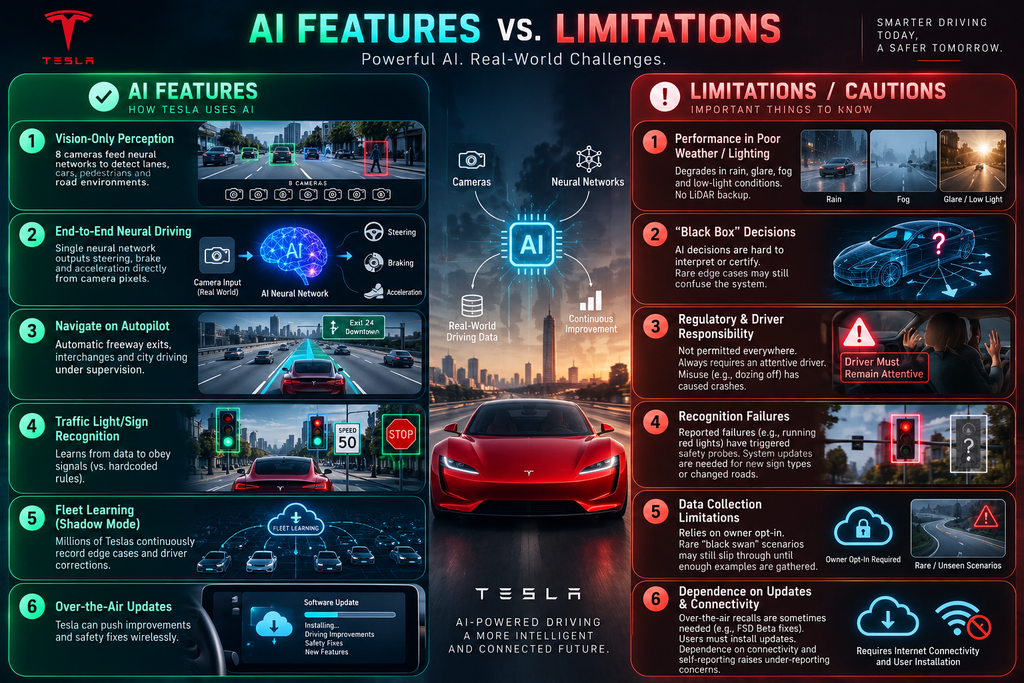
Beyond the Roadster, Tesla’s reputation rests on its AI-driven Autopilot/FSD systems. Unlike traditional automakers that use LIDAR/radar, Tesla relies solely on cameras and neural networks for autonomy. Each Tesla (2023+) comes with an FSD computer (HW4) that processes data from eight wide-angle cameras providing 360° vision. Tesla’s official AI page notes: “Our per-camera networks analyze raw images to perform segmentation, object detection and depth estimation. 48 networks take 70,000 GPU-hours to train… together they output 1,000 distinct predictions at each timestep.”. In short, vision AI in Tesla cars turns pixel streams into driving commands.
Tesla’s software has undergone a radical shift. Early Autopilot used rule-based code (hundreds of thousands of lines of C++), but by late 2023, Tesla had transitioned to an end-to-end neural network architecture (FSD v12). As Fred Pope reports, Elon Musk emphasized: “There are over 300,000 lines of C++ in version 11, and there’s basically none of that in version 12.” Instead, raw camera data directly produces steering/braking commands through neural nets. Tesla now trains its driving models on billions of miles of fleet data. Every Tesla on the road runs FSD (or Autopilot) in “shadow mode,” recording video clips of corner cases and driver interventions. This allows iterative learning: new software releases continuously improve the neural nets. Tesla even built a custom Dojo supercomputer to accelerate training.
Although the Tesla Roadster 2026 has attracted attention for its futuristic design, its specific production AI and autonomous-driving capabilities have not all been confirmed.
Tesla FSD v13 and v14 (2024-25): Building on v12’s success, Tesla has iterated quickly. In 2024 and 2025 Tesla released FSD v13 and v14: each version expanded the neural net size and capabilities. For example, FSD v14 (Oct 2025) increased model capacity ~10× over v12. Tesla’s custom HW4 chip (introduced 2023) is 3–8× more powerful than HW3, enabling these huge networks. Today, Tesla reports over 8.5 billion supervised miles driven by FSD cars. With each update, Tesla claims reduced intervention rates (v12.5 was 100× safer than v11, v13 forecasted another 10× improvement).
Despite progress, Tesla’s FSD is not fully autonomous. It’s best described as Level 2 driver assistance (the driver must supervise). The system can navigate on highways and residential streets (stop signs, traffic lights) under supervision, but it “will drive you almost anywhere with your active supervision, requiring minimal intervention” – Tesla’s words. U.S. regulators echo this: in 2025 NHTSA opened a probe into 2.9M Teslas over FSD-related traffic violations (running red lights, wrong-way turns). NHTSA emphasized that FSD is “an assistance system that requires drivers to pay attention” and that misuse can pose dangers. Tesla itself warns drivers to keep hands on the wheel; if they relax too much, FSD can disengage.
The Tesla Roadster 2026 combines an all-electric sports-car design with performance-focused engineering. Its final production specifications should be verified against official announcements.
In summary, Tesla’s AI allows advanced features (Autosteer, Traffic-Aware Cruise, Navigate on Autopilot, Auto Lane Change, Autopark, Summon) by using large neural nets trained on fleet data. But these features have limitations and safeguards. For example, in bad visibility (glare, dust, rain), the vision-only approach can struggle – NHTSA cited crashes where FSD “did not detect visibility impairment” until it was too late. As Tesla’s engineering team notes, while neural nets handle complex scenes, regulators worry that their “black box” nature makes failures hard to analyze. Tesla’s counter is that vast miles and crash statistics (they’ve logged hundreds of billions of miles driven by FSD) will demonstrate safety statistically, even if the model’s reasoning is opaque.
The Tesla Roadster 2026 represents an ambitious vision for electric sports cars. Its eventual production features and software capabilities will determine how it compares with other next-generation electric vehicles.
Frequently Asked Questions (FAQ)
Q1: What’s new about the 2026 Tesla Roadster?
A: The new Roadster sports a dramatically revised design and two radical tech systems. First, a suction fan underbody provides immense downforce (Tesla jokes the car can stick to a ceiling). Second, SpaceX-derived cold-gas thrusters allow the car to jump and flip. It was shown demonstrating hops and spins with a total of 10 thrusters powered by 600 L of compressed air. Performance claims include ~300 mi range, >230 mph top speed, and ~0.8s 0–60. These demos (0.81s run, flying maneuvers) were prototype demonstrations – production specs may vary. Tesla emphasizes that some features (like the single-seat Rocket flying mode) are for shows/track use only. The reveal also showed a more angular, stealthy look (hidden headlights, SR-71-inspired form) with extensive use of lightweight materials.
Q2: When will the new Roadster be available?
A: Tesla says 2028 is the target for volume production. Initial demonstrations suggest availability only to reservation holders. Given past delays (the car was first promised for 2020!), buyers should temper expectations. Tesla’s CEO has repeatedly pushed timelines; the latest public statements still say 2028. If 2028 holds, engineering and testing are likely ramping up now.
Q3: How do the Performance, Thrust, and Rocket trims differ?
A: The Performance trim is a track-ready two-seater with active aerodynamics and the suction-fan system. It has no thrusters, making it suitable for road use. The Thrust trim adds rear-mounted cold-gas thrusters (four nozzles) for extreme acceleration and jumps; it’s limited-release with dual seats and a higher price (reservation was $250k). The Rocket trim is a one-seater experimental version: it has 10 thrusters (four beneath, two on nose) fed by extra tanks (600 L of gas), enabling full “flight” demonstrations. Rocket is essentially a show car (not street-legal). Top speeds and acceleration improve from Perf→Thrust→Rocket.
Q4: Is the Roadster really a flying car?
A: Sort of. In demo runs, the Rocket variant briefly flew over a ramp and did barrel rolls. Those stunts used the thrusters to overcome gravity for short bursts. However, this isn’t sustained flight like an airplane – more like a rocket-propelled jump/fly-by-wire trick. Tesla’s claims and Musk’s statements suggest Roadster could “fly” if asked, but this requires special conditions (high pressure, etc.). In normal operation (Performance/Thrust trims), you would never reach those heights or maneuvers. The thrusters primarily boost acceleration on the ground. Notably, the “Rocket” one-seat trim is not approved for roads – it’s explicitly a private-track device.
Q5: What is Tesla’s Full Self-Driving (FSD) and how does it work?
A: Tesla’s FSD is an advanced driver-assist suite. It can steer, brake, change lanes, and handle intersections under driver supervision. Technically, it’s powered by deep neural networks running on Tesla’s custom HW4 computer. The system processes inputs from 8 cameras (and some ultrasound) through 48 neural networks to perceive and plan. It then outputs steering/braking. Tesla trains these nets end-to-end on massive data from its fleet. FSD learns from real driving examples (shadow mode, driver interventions) and is updated over-the-air. It’s unique in that Tesla removed ~300k lines of hand-written code in FSD v12, relying instead on learning behavior from data.
Q6: Is FSD fully autonomous?
A: No. Tesla’s FSD still legally requires an attentive driver. The company and regulators stress FSD is an “assistance system”. Tesla’s own materials say it “will drive you almost anywhere with active supervision, requiring minimal intervention”. In practice, drivers must keep hands on the wheel and eyes on the road. Current FSD has restrictions (e.g. not on all highways or cities, depending on local approval). NHTSA investigations (2024–26) of Tesla’s FSD emphasize this: crashes have occurred when drivers over-trusted FSD, and regulators warn that cameras alone (with no lidar) can fail in glare or fog.
Q7: How is Tesla using AI beyond driving?
A: Tesla’s AI efforts span robotics and chip design too. The same neural-network expertise behind Autopilot is being applied to Tesla’s humanoid robot Optimus. Tesla also designs its own FSD inference chip and the Dojo training hardware. While outside car scope, it underscores Tesla’s “AI-first” strategy.
Q8: What safety/legal issues should buyers know?
A: Buyers should be aware the Roadster is a halo car, not a mainstream daily driver. Key points: the high-pressure COPV tanks and thrusters carry risks (COPVs have been involved in rocket failures). Tesla filled every void with carbon-fiber pressure vessels – a point of concern for some engineers. The company notes that high-demand Rocket trim may violate regional laws: “not available in all regions,” and any thruster system is subject to local legal requirements. On AI, remember: even if FSD is enabled, it isn’t true self-driving. All Teslas (except perhaps the Roadster) will have driver-monitoring to ensure hands are ready.
Leave a Reply